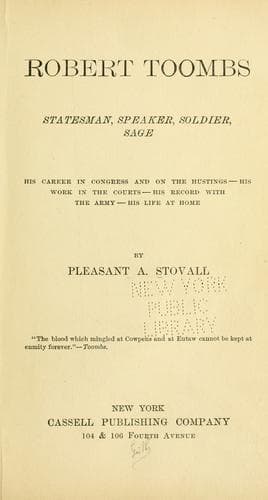
Robert Toombs: Statesman, Speaker, Soldier, SageStovall, Pleasant A.
History
Robert Toombs: Statesman, Speaker, Soldier, Sage
Stovall, Pleasant A.
Toombs, Robert Augustus, 1810-1885
Toombs and Stephens, in fact, were warm personal friends of George W.
Crawford, who was Secretary of War in Taylor's Cabinet. He had served
with them in the General Assembly of Georgia and had twice been Governor
of their State. The Golphin claim, of which Governor Crawford had been
agent, had been collected from the Secretary of the Treasury while
Governor Crawford was in the Cabinet, but President Taylor had decided
that as Governor Crawford was at the head of an entirely different
department of the government, he had been guilty of no impropriety.
After the death of President Taylor, Governor Crawford returned to
Augusta and was tendered a public dinner by his fellow-citizens,
irrespective of party. He delivered an eloquent and feeling address. He
made an extensive tour abroad, then lived in retirement in Richmond
County, enjoying the respect and confidence of his neighbors.
CHAPTER VI.
THE COMPROMISE OF 1850.
No legislative body ever assembled with more momentous measures before
it than the thirty-first Congress of the United States. An immense area
of unsettled public domain had been wrested from Mexico. The Territories
of California, Utah, and New Mexico, amounting to several hundred
thousand square miles, remained undisposed of. They comprised what Mr.
Calhoun had termed the "Forbidden Fruit," and the trouble which
beclouded their annexation threatened to surpass the storms of conquest.
Congress felt that it was absolutely without light to guide it. It had
declined to extend the Missouri Compromise line to the Pacific Ocean.
Henry Clay had pronounced such division of public domain between the
sections a "Utopian dream," and Zachary Taylor had condemned the
principle in the only message he ever delivered to Congress. What Mr.
Lincoln afterward embodied in his famous expression that the Union could
never exist "half slave, half free," had been actually anticipated. The
whole territorial question came up as a new problem. But if the crisis
was now momentous the body of statesmen which considered it was a great
one. The men and the hour seemed to meet in that supreme moment. The
Senate consisted of sixty members, and for the last time that great trio
of Clay, Calhoun, and Webster met upon its floor. Commencing their
careers a generation before; with eventful lives and illustrious
performance, they lingered one moment in this arena before passing
forever from the scenes of their earthly efforts. All three had given up
ambition for the Presidency, none of them had commenced to break in
mental power, and each one was animated by patriotism to serve and save
his country. William H. Seward had entered the Senate from New York;
James M. Mason and Robert M. T. Hunter represented Virginia; Wm. C.
Dawson had joined Mr. Berrien from Georgia; Salmon P. Chase appeared
from Ohio; Jefferson Davis and Henry S. Foote illustrated Mississippi;
Stephen A. Douglas had been promoted from the House in Illinois, and
Samuel Houston was there from Texas.
Public-domain text, read in full here on John Shaqi.
Reviews
Reviews
No reviews yet
Be the first to share your thoughts on this work.
Join the Discussion
Join the discussion
Sign in to leave a comment or review.
Sign InorCreate an account