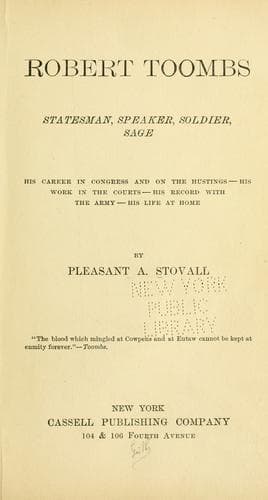
Robert Toombs: Statesman, Speaker, Soldier, SageStovall, Pleasant A.
History
Robert Toombs: Statesman, Speaker, Soldier, Sage
Stovall, Pleasant A.
Toombs, Robert Augustus, 1810-1885
"I intend to drag off the mask before the consummation of the act. We do
not oppose California on account of the antislavery clause in her
constitution. It was her right, and I am not even prepared to say she
acted unwisely in its exercise--that is her business: but I stand upon
the great principle that the South has the right to an equal
participation in the Territories of the United States. I claim the right
for her to enter them with all her property and security to enjoy it.
She will divide with you if you wish it: but the right to enter all, or
divide, I will never surrender. In my judgment this right, involving, as
it does, political equality, is worth a dozen such Unions as we have,
even if each were a thousand times more valuable than this. I speak not
for others, but for myself. Deprive us of this right, and appropriate
this common property to yourselves; it is then your government, not
mine. Then I am its enemy, and I will then, if I can, bring my children
and my constituents to the altar of liberty, and like Hamilcar, I will
swear them to eternal hostility to your foul domination. Give us our
just rights, and we are ready, as ever heretofore, to stand by the
Union, every part of it, and its every interest. Refuse it, and, for
one, I will strike for independence."
Mr. Stephens declared that this speech produced the greatest sensation
he had ever seen in the House. "It created a perfect commotion."
These heated arguments of Mr. Toombs were delivered under the menace of
the Wilmot Proviso, or slavery restriction. When this principle was
abandoned and the compromise measures passed, Mr. Toombs uttered, as we
shall see, far different sentiments.
In the Senate Mr. Clay, the Great Pacificator, had introduced his
compromise resolutions to admit California under the government already
formed, prohibiting slavery; to organize territorial governments for
Utah and New Mexico without slavery restrictions; to pass a
fugitive-slave law, and to abolish the slave trade in the District of
Columbia. On the 7th of March, 1850, Mr. Webster delivered his great
Union speech, in which for the first time he took strong grounds against
congressional restriction in the Territories. It created a profound
sensation. It was on the 4th of March that Senator Mason read for Mr.
Calhoun the last speech that the latter ever prepared. It was a
memorable moment when the great Carolinian, with the stamp of death
already upon him, reiterated his love for the Union under the
Constitution, but declared, with the prescience of a seer, that the only
danger threatening the government arose from its centralizing tendency.
It was "the sunset of life which gave him mystical lore."
Debate continued through the spring and summer with increasing
bitterness. On the 31st of July Mr. Clay's "Omnibus Bill," as it was
called, "went to pieces," but the Senate took up the separate
propositions, passed them, and transmitted them to the House.
Public-domain text, read in full here on John Shaqi.
Reviews
Reviews
No reviews yet
Be the first to share your thoughts on this work.
Join the Discussion
Join the discussion
Sign in to leave a comment or review.
Sign InorCreate an account