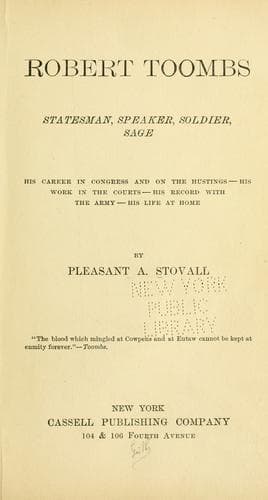
Robert Toombs: Statesman, Speaker, Soldier, SageStovall, Pleasant A.
History
Robert Toombs: Statesman, Speaker, Soldier, Sage
Stovall, Pleasant A.
Toombs, Robert Augustus, 1810-1885
Mr. Toombs called on all men of integrity, intellect, and courage to
come into the service of the State and prove their devotion to the
Constitution and the Union. "With no memory of past differences," he
said, "careless of the future, I am ready to unite with any portion or
all my countrymen in defense of the integrity of the republic."
Mr. Toombs took the stump, and his words rang out like an alarm bell.
Men speak to-day of his activity and earnestness in that great campaign,
as with "rapid and prompt perception, clear, close reasoning, cutting
eloquence, and unsparing hand he rasped the follies of disunion and
secession." A prominent journal of that day, speaking of his speech in
Burke County, Ga., declared that "his manly eloquence has shaken and
shivered to the base the pedestal upon which the monument of American
ruin was to be erected."
In November of that year a convention of delegates from Southern States
was held at Nashville. Ex-Governor Charles J. McDonald represented
Georgia. That meeting protested against the admission of California with
slavery restriction; charged that the policy of Congress had been to
exclude the Southern States from the Territories, and plainly asserted
that the powers of the sovereign States could be resumed by the States
separately. On November 3 the election of delegates to the Georgia
convention was held. Toombs had already turned the tide. A great
majority of Union men were chosen. Whigs and Democrats united to save
the State. Toombs stood convicted before many of his old followers of
"unsoundness on the slavery question"--but he was performing his
greatest public work.
Among the delegates elected by the people to the Georgia convention,
which met at Milledgeville, December 10, 1850, were Toombs and Stephens
and many of the best men in the State.
The work of the distinguished body was memorable. They adopted the
celebrated "Georgia Platform," whose utterances were talismanic. Charles
J. Jenkins reported the resolutions. They recited, first, that Georgia
held the American Union secondary in importance to the rights and
principles it was bound to perpetuate. That as the thirteen original
colonies found union impossible without compromise, the thirty-one of
this day will yield somewhat in the conflict of opinion and policy, to
preserve the Union. That Georgia had maturely considered the action of
Congress (embracing the compromise measures) and--while she does not
wholly approve it--will abide by it as a permanent adjustment of this
sectional controversy. That the State would in future resist, even to
the disruption of the Union, any act prohibiting slavery in the
Territories, or a refusal to admit a slave State. The fifth plank
declared for a faithful execution of the Fugitive-slave bill.
Public-domain text, read in full here on John Shaqi.
Reviews
Reviews
No reviews yet
Be the first to share your thoughts on this work.
Join the Discussion
Join the discussion
Sign in to leave a comment or review.
Sign InorCreate an account