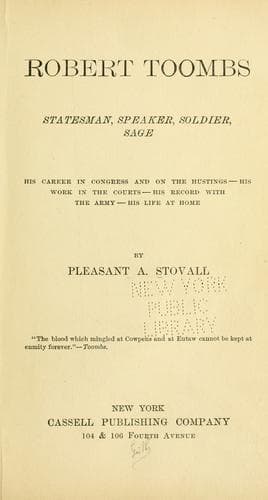
Robert Toombs: Statesman, Speaker, Soldier, SageStovall, Pleasant A.
History
Robert Toombs: Statesman, Speaker, Soldier, Sage
Stovall, Pleasant A.
Toombs, Robert Augustus, 1810-1885
"What did this party demand, and what did it get?" he asked on the
stump. "It was driven from every position it assumed. It demanded the
express prohibition of slavery, the Wilmot Proviso, in the Territories.
It lost it. It demanded the abolition of slavery in the District of
Columbia, and the slave trade between the States. It lost both. It
demanded the affirmance of the oft-repeated declaration that there
should be no more slave States admitted into the Union. Congress
enacted that States hereafter coming into the Union should be admitted
with or without slavery, as such States might determine for themselves.
It demanded a trial by jury for fugitives at the place of arrest. It
lost this also. Its acknowledged exponent is the Free-Soil party. The
Whig party has succumbed to it. It is thoroughly denationalized and
desectionalized, and will never make another national contest. We are
indebted to the defeat of the policy of these men for the existence of
the government to-day. The Democratic party of the North, though
prostrated, is not yet destroyed. Our true policy is to compel both
parties to purge themselves of this dangerous element. If either will,
to sustain it. If neither will, then we expect to preserve the Union. We
must overthrow both parties and rally the sound men to a common
standard. This is the only policy which can preserve both our rights and
the Union."
On the 1st of August, 1851, Mr. Toombs spoke in Elberton. He was in the
full tide of his manhood, an orator without equal; a statesman without
fear or reproach. Personally, he was a splendid picture, full of health
and vitality. He had been prosperous in his affairs. He was prominent in
public life and overbore all opposition. His powers were in their prime.
In his speech to his constituents he mentioned the fact that his
opponents had criticised the manner in which he traveled (alluding to
his fine horses and servants). He wanted the people to know that the
money was his, and that he made $5000 a year in Elbert alone. "Who would
say that he had not earned his money? He had a right to spend it as he
chose. Perish such demagogy--such senseless stuff." The people cheered
him to the echo for his candor and audacity.
"What presumption," he said, "for the States' Rights men to nominate
McDonald for Governor--a man who supported Jackson's Force bill--a man
who had grown gray in federalism? He was the man brought to teach the
people of Elbert States' Rights. It would be a curious subject of
inquiry to find out when this neophyte had changed, and by what process
the change had been wrought."
Toombs was alluded to by the correspondents as "Richard, the
Lion-hearted," with strong arm and ponderous battle-ax, as he went about
winning victories. Stephens, no less effective and influential, seemed
to be the great Saladin with well-tempered Damascus blade--so skillful
as to sever the finest down. The people were in continued uproar as
Toombs moved from place to place.
Public-domain text, read in full here on John Shaqi.
Reviews
Reviews
No reviews yet
Be the first to share your thoughts on this work.
Join the Discussion
Join the discussion
Sign in to leave a comment or review.
Sign InorCreate an account