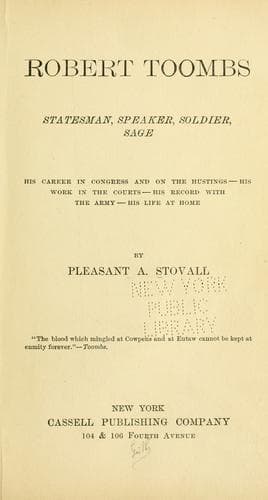
Robert Toombs: Statesman, Speaker, Soldier, SageStovall, Pleasant A.
History
Robert Toombs: Statesman, Speaker, Soldier, Sage
Stovall, Pleasant A.
Toombs, Robert Augustus, 1810-1885
As the campaign became more heated, Toombs, Stephens, and Cobb redoubled
their efforts and drew their lines more closely. This combination was
invincible. It was evident that they would carry the State, but some of
the prominent men in Georgia were ruled out under what was thought to be
the bitter spirit of the canvass. One of these was Charles J. Jenkins,
and the other, John McPherson Berrien. The former had drawn the
celebrated Georgia Platform, and was devoted to the Union. The latter
was United States Senator from Georgia, and, as his successor was to be
chosen by the legislature soon to be elected, there was much curiosity
to find out his real position in this canvass. Mr. Jenkins declared that
he considered Mr. Berrien "as good a Union man and as safe a
representative of the party as any within its ranks." Berrien acquiesced
in but did not eulogize the compromise measures. He did not oppose or
favor the State convention of 1850. When he submitted to the Senate the
Georgia Platform, he declared that he did not surrender the privileges
of a free choice. He supported McDonald for Governor against Cobb, and
it was soon evident that he was not in full sympathy with the winning
party.
The Constitutional Union men won a signal victory. Howell Cobb was
elected Governor by a large majority over Charles J. McDonald, who had
been twice Governor and who was one of the strongest men in Georgia.
Robert Toombs was reelected to Congress over Robert McMillen of Elbert,
and Mr. Stephens defeated D. W. Lewis of Hancock.
The legislature convened in November, 1851. It was largely made up of
Union men. Judge Berrien was not a candidate for reelection to the
United States Senate. He wrote a letter in which he reviewed his course
during the campaign. He said:
"I asserted in terms which even cavilers could not
misunderstand nor any honest man doubt, my devotion to the
Union, my unfaltering determination to maintain by all
constitutional means, and with undiminished zeal, the equal
rights of the South, and my acquiescence in the compromise
measures. Satisfied that such declarations, in the excited
state of feeling, would not meet the exactions of either
party in a contest peculiarly bitter, and unable to
sacrifice for the purpose of victory the dictates of
conscience or the convictions of judgment, I expressed a
willingness to retire."
On the 10th of November Robert Toombs was elected United States Senator.
In the caucus he secured 73 votes, and in the open Assembly next day he
received 120 votes, scattering, 50.
Never was reward more swift or signal to the master-mind of a campaign.
If he had been the leader of the extreme Southern wing in Congress, he
had shown his willingness to accept a compromise and go before the
people in defense of the Union.
Public-domain text, read in full here on John Shaqi.
Reviews
Reviews
No reviews yet
Be the first to share your thoughts on this work.
Join the Discussion
Join the discussion
Sign in to leave a comment or review.
Sign InorCreate an account