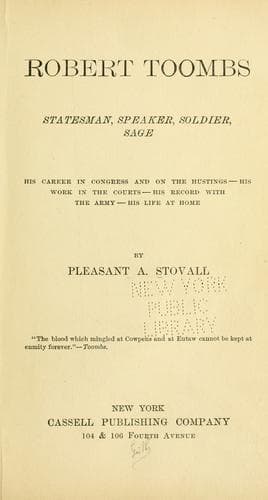
Robert Toombs: Statesman, Speaker, Soldier, SageStovall, Pleasant A.
History
Robert Toombs: Statesman, Speaker, Soldier, Sage
Stovall, Pleasant A.
Toombs, Robert Augustus, 1810-1885
In this first struggle between Secession and the Union Georgia had taken
the lead, but Georgia had not been the only State involved. The fight
was waged just as fiercely in Mississippi, when Henry S. Foote, the
Union candidate, was elected Governor over Jefferson Davis. But the
Georgia Platform was the corner-stone of the Southern victory. Her
action gave peace and quiet to the whole Union, and the success of the
triumvirate that year offered assurance of strength and security to the
country. The national parties were quick to align themselves on this
platform. The Democratic convention, which assembled in Baltimore June
1, declared that "the party would abide by and adhere to a faithful
execution of the Acts known as the Compromise Measures, settled by the
last Congress." The Whig convention, which met also at Baltimore, June
16, proclaimed that "the series of Acts of the thirty-first Congress,
known as the Compromise Measures of 1850, the Act known as the
Fugitive-slave law included, are received and acquiesced in by the Whig
party of the United States as a settlement in principle and substance
of the dangerous and exciting questions which they embrace."
"The truth is," said Mr. Stephens in his "War Between the States," "an
overwhelming majority of the people, North as well as South, was in
favor of maintaining these principles."
Under these conditions the presidential campaign of 1852 was opened. The
Southern Whigs did not, as a body, accept the Baltimore nominee, General
Winfield Scott. They claimed that he had refused to express any direct
approval of the platform relating to the compromise. Mr. Toombs demanded
that his candidate plant himself unequivocally upon this platform. He
noticed that the opponents of the Fugitive-slave law were strong for
Scott. Feeling in the South was still running high. Some extremists held
that no Northern man was fit to be trusted. Mr. Toombs declared that
there were good and true men at the North and that he would "hold party
associations with no others."
In a speech to his own townspeople in Washington, Ga., during this
presidential campaign, Mr. Toombs declared that he had not changed one
iota, but was ready now to support the men who would plant themselves on
the broad principles of the Constitution and the country. He said
General Scott had no claims whatever upon the people. He spoke of him as
a great general, and alluded in glowing terms to his achievements in
arms against the Mexicans and Indians. But General Scott, he believed,
was a Free-Soil candidate. He would be in favor of annexing Canada, but
no more slave territory. Mr. Toombs alluded to the Democratic candidate
for President, General Franklin Pierce, as a very consistent man in all
his senatorial career, and believed he was the safest man on the slavery
question north of Mason and Dixon's line. He preferred Pierce to Scott,
but said he would not vote for either. The contest was "between a big
general and a little general."
Public-domain text, read in full here on John Shaqi.
Reviews
Reviews
No reviews yet
Be the first to share your thoughts on this work.
Join the Discussion
Join the discussion
Sign in to leave a comment or review.
Sign InorCreate an account