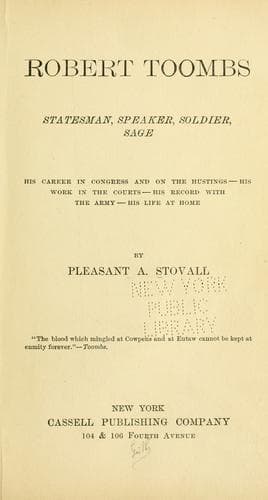
Robert Toombs: Statesman, Speaker, Soldier, SageStovall, Pleasant A.
History
Robert Toombs: Statesman, Speaker, Soldier, Sage
Stovall, Pleasant A.
Toombs, Robert Augustus, 1810-1885
Mr. Toombs: "You said it. I have it before me in your printed speech. I
heard it delivered, and you are correctly reported."
In a letter to Mr. B. F. Hallet of Boston, in 1856, Mr. Toombs denied
saying that he would "call the roll of his slaves at the base of Bunker
Hill Monument." He charged Senator Hale with misrepresenting him to this
extent.
No man was oftener misquoted by word of mouth or in public print. As
bold as he was in speech and as free to speak out what was in his mind,
he once remarked to an intimate friend, Dr. Steiner of Augusta, that he
rarely ever saw his name in print that it was not attached to a lie.
We are not left to tradition or the dictum of political opponents to
know how seriously Mr. Toombs regarded the question of war between the
North and South. In this same debate with Senator Hale, Mr. Toombs said:
"He told us the North would fight. I believe that nobody ever doubted
that any portion of the United States would fight on a proper occasion.
Sir, if there shall ever be civil war in this country, when honest men
shall set about cutting each other's throats, those who are least to be
depended upon in a fight will be the people who set them at it. There
are courageous and honest men enough in both sections to fight.... No,
sir, there is no question of courage involved. The people of both
sections of the Union have illustrated their courage on too many
battlefields to be questioned. They have shown their fighting qualities,
shoulder to shoulder, whenever their country has called upon them; but
that they may never come in contact with each other in fratricidal war,
should be the ardent wish and earnest desire of every true man and
honest patriot."
CHAPTER X.
THE "KNOW-NOTHING" PARTY.
In the fall of 1854 the elections were generally adverse to the
Democrats. The slavery agitation at the North, intensified by the
passage of the Kansas-Nebraska bill, resulted in a large number of
Free-Soil candidates and "anti-Nebraska" Whigs being elected to the
House. In the West and South, the "Know-nothing" movement had arisen as
in a single night, and with secrecy and strength had asserted itself on
election day. The consequence was that the Democratic majority in the
House which had been elected with Franklin Pierce now disappeared. The
years of 1854-55 were full of uncertainty in Georgia. The old-line
Whigs, who had broken away from their party associates upon the
nomination of General Scott for President, had not yet gone into full
affiliation with the Democrats. Many of these men joined the "American
party," which had arisen out of antagonism to the large foreign
population flowing into the States and Territories. This party put out
candidates for Congress and the State offices in Georgia.
Public-domain text, read in full here on John Shaqi.
Reviews
Reviews
No reviews yet
Be the first to share your thoughts on this work.
Elsewhere in the archive
Join the Discussion
Join the discussion
Sign in to leave a comment or review.
Sign InorCreate an account