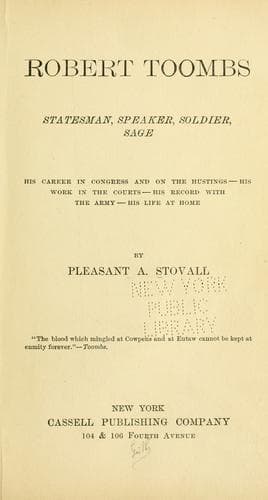
Robert Toombs: Statesman, Speaker, Soldier, SageStovall, Pleasant A.
History
Robert Toombs: Statesman, Speaker, Soldier, Sage
Stovall, Pleasant A.
Toombs, Robert Augustus, 1810-1885
On the evening of the 24th of January, Mr. Toombs ascended the stage at
Tremont Temple. A large audience greeted him. There was great curiosity
to see the Southern leader. They admired the splendid audacity of this
man in coming to the place where Garrison had inveighed against slavery
and had denounced the Constitution as a "league with Hell and a covenant
with the Devil"; where Wendell Phillips had exerted his matchless
oratory, and where Charles Sumner had built up his reputation as an
unflagging enemy of Southern propagandism. Mr. Toombs was in good trim
for this supreme effort. Inspired by the significance of his mission, he
seemed possessed of unusual strength. His fine eye lighted with his
theme, and his brow seemed stamped with confidence rather than defiance.
His long, black hair was brushed from his forehead, and his deep voice
filled the historic hall. He was indeed a fine specimen of a man--a Saul
among his fellows. Possibly he was moved by the thought that he stood
where Webster had pleaded for the Union, for concession, and for harmony
six years before, when the people for the first time had turned from him
and when Fanueil Hall had been closed against him.
Senator Toombs was attended upon the stage by William and Nathan
Appleton, whose guest he was. Their presence was a guarantee that the
speaker should receive a respectful hearing. It was noticed at the
outset that he had abandoned his fervid style of speaking. He delivered
his address from notes in a calm and deliberate manner. He never
prepared a speech with so much care. His discourse was so logical and
profound, his bearing so dignified and impressive, that his hearers were
reminded of Webster.
It was evident early in the evening that his lecture would produce a
powerful effect. To many of his hearers his views were novel and fresh,
as they had never heard the Southern side of this great question. "With
the exception of Sam Houston," said a New York paper, "Mr. Toombs is the
only Southern man who has had the pluck to go into the antislavery camp
and talk aloud of the Constitution. Other Southern men, not afraid to
face Boston, have been afraid to face opinion at home."
In referring to the clause of the Constitution providing for the return
of fugitive slaves, Mr. Toombs was greeted by a hiss. The speaker turned
in the direction of the noise and said, "I did not put that clause
there. I am only giving the history of the action of your own John
Adams; of your fathers and mine. You may hiss them if you choose." The
effect was electrical. The hiss was drowned in a storm of applause. The
readiness and good-nature of the retort swept Boston off her feet, and
for one moment prejudice was forgotten.
Public-domain text, read in full here on John Shaqi.
Reviews
Reviews
No reviews yet
Be the first to share your thoughts on this work.
Elsewhere in the archive
Join the Discussion
Join the discussion
Sign in to leave a comment or review.
Sign InorCreate an account