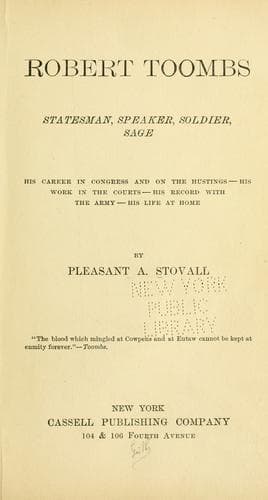
Robert Toombs: Statesman, Speaker, Soldier, SageStovall, Pleasant A.
History
Robert Toombs: Statesman, Speaker, Soldier, Sage
Stovall, Pleasant A.
Toombs, Robert Augustus, 1810-1885
The New York _Express_ declared that the speaker was earnest and
deliberate, presenting his argument with great power, and his lecture of
an hour and a half was, for the most part, listened to with respect and
attention. There was some conduct in the audience at the close which the
Boston _Journal_ was forced to denounce as "ungentlemanly." Three
cheers, not unmixed with dissent, were given to the distinguished
speaker. Someone called out, "When will Charles Sumner be allowed to
speak in the South?"
The New York _Express_ declared that "if Toombs and other hotheads would
lecture in Syracuse, Oswego, Ashtabula, and other points of 'Africa,'
they would do a good deal of good in educating the innocents and
becoming themselves educated and freed from fire, froth, fury, and
folly."
This lecture of Mr. Toombs at Boston will live as the most lucid defense
of slavery in law and in practice ever delivered. Slavery has fallen and
mankind has made up its verdict; but this address will still be read
with interest.
He did not hesitate to say that Congress had no right to limit,
restrain, or impair slavery; but, on the contrary, was bound to protect
it. At the time of the Declaration of Independence, slavery was a fact.
The Declaration did not emancipate a single slave; neither did the
Articles of Confederation. The Constitution recognized slavery. Every
clause relative to slavery was intended to strengthen and protect it.
Congress had no power to prohibit slavery in the Territories. The clause
giving Congress power to make regulations for the Territories did not
confer general jurisdiction. It was not proper nor just to prohibit
slavery in the Territories. Penning the negro up in the old States would
only make him wretched and miserable, and would not strike a single
fetter from his limbs. Mr. Toombs simply asked that the common territory
be left open to the common enjoyment of all the people of the United
States; that they should be protected in their persons and property by
the general government, until its authority be superseded by a State
constitution, when the character of their democratic institutions was to
be determined by the freemen thereof. "This," he said, "is justice. This
is constitutional equity." Mr. Toombs contended that the compromise
measures of 1850 and the Kansas-Nebraska Act of 1854 were made to
conform to this policy. "I trust--I believe," he continued, "that when
the transient passions of the day shall have subsided, and reason shall
have resumed her dominion, it will be approved, even applauded, by the
collective body of the people."
Public-domain text, read in full here on John Shaqi.
Reviews
Reviews
No reviews yet
Be the first to share your thoughts on this work.
Elsewhere in the archive
Join the Discussion
Join the discussion
Sign in to leave a comment or review.
Sign InorCreate an account