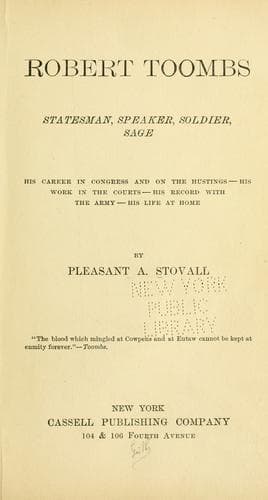
Robert Toombs: Statesman, Speaker, Soldier, SageStovall, Pleasant A.
History
Robert Toombs: Statesman, Speaker, Soldier, Sage
Stovall, Pleasant A.
Toombs, Robert Augustus, 1810-1885
Upon the second branch of his theme, Mr. Toombs contended that so long
as the African and Caucasian races co-exist in the same society, the
subordination of the African is the normal and proper condition, the one
which promotes the highest interests and greatest happiness of both
races. The superiority of the white man over the black, he argued, was
not transient or artificial. The Crown had introduced slavery among the
American colonists. The question was not whether it was just to tear the
African away from bondage in his own country and place him here.
England had settled that for us. When the colonies became free they
found seven hundred thousand slaves among them. Our fathers had to
accept the conditions and frame governments to cover it. They
incorporated no Utopian theories in their system. They did not so much
concern themselves about what rights man might possibly have in a state
of nature, as what rights he ought to have in a state of society. The
lecturer maintained that under this system, the African in the
slaveholding States is found in a better position than he has ever
attained in any other age or country, whether in bondage or freedom. The
great body of this race had been slaves in foreign lands and slaves in
their native land. In the Eastern Hemisphere the African had always been
in a servile condition. In Hayti and Jamaica experiments had been tried
of freeing them, under the auspices of France and England. Miseries had
resulted and ruin overwhelmed the islands. "Fanaticism may palliate, but
could not conceal the utter prostration of the race." The best specimens
of the race were to be found in the Southern States, in closest contact
with slavery. The North does not want the negro, does not encourage his
immigration. The great fact of the inferiority of the race is admitted
everywhere in our country.
"Our political system gives the slave great and valuable rights. His
life is protected; his person secured from assault against all others
except his master, and his master's power in this respect is placed
under salutary legal restriction." He gets a home, ample clothing and
food, and is exempted from excessive labor. When no longer capable of
labor, from age or disease, he is a legal charge upon his master. The
Southern slave, he said, is a larger consumer of animal food than any
population in Europe, and larger than any laboring population in the
United States, and their natural increase is equal to that of any other
people. Interest and humanity cooperate in harmony for the well-being of
slave labor. Labor is not deprived of its wages. Free labor is paid in
money, the representative of products; slave labor in the products
themselves. The agricultural and unskilled laborers of England fail to
earn the comforts of the Southern slave. The compensation of labor in
the Old World has been reduced to a point scarcely adequate to the
continuation of the race.
Public-domain text, read in full here on John Shaqi.
Reviews
Reviews
No reviews yet
Be the first to share your thoughts on this work.
Elsewhere in the archive
Join the Discussion
Join the discussion
Sign in to leave a comment or review.
Sign InorCreate an account