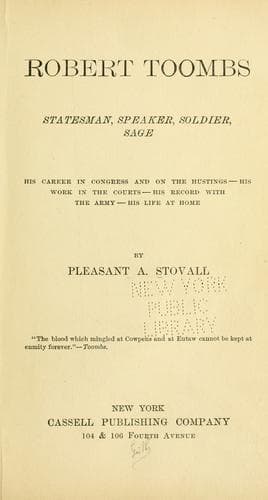
Robert Toombs: Statesman, Speaker, Soldier, SageStovall, Pleasant A.
History
Robert Toombs: Statesman, Speaker, Soldier, Sage
Stovall, Pleasant A.
Toombs, Robert Augustus, 1810-1885
Senator Toombs combated the idea that slavery debased and enervated the
white man. To the Hebrew race were committed the orders of the Most
High. Slaveholding priests ministered at their altars. Greece and Rome
afforded the highest forms of civilization. Domestic slavery neither
enfeebles nor deteriorates a race. Burke had declared that the people of
the Southern colonies of America were much more strongly, and with a
higher and more stubborn spirit, attached to liberty that those to the
Northward. Such were our Gothic ancestors; such were the Poles; such
will be all masters of slaves who are not slaves themselves. In such a
people the haughtiness of domination combines itself with the spirit of
freedom, fortifies it, and renders it invincible.
Senator Toombs declared that, in the great agitation which for thirty
years had shaken the national government to its foundation and burst
the bonds of Christian unity among the churches, the slaveholding States
have scarcely felt the shock. Stability, progress, order, peace,
content, prosperity reign through our borders. Not a single soldier is
to be found in our domain to overawe or protect society. Mr. Toombs
pictured the progress of the Southern churches, schools and colleges
multiplying. None of these improvements had been aided by the Federal
Government. "We have neither sought from it protection for our private
interests nor appropriations for our public improvements. They have been
effected by the unaided individual efforts of an enlightened, moral, and
energetic people. Such is our social system and such our condition under
it. We submit it to the judgment of mankind, with the firm conviction
that the adoption of no other, under such circumstances, would have
exhibited the individual man, bond or free, in a higher development or
society in a happier civilization."
Mr. Toombs carried his principles into practice. He owned and operated
several large plantations in Georgia, and managed others as agent or
executor. He had the care of, possibly, a thousand slaves. His old
family servants idolized him. Freedom did not alter the tender bond of
affection. They clung to him, and many of them remained with him and
ministered to his family to the day of his death. The old plantation
negroes never failed to receive his bounty or good will. During the
sale of a plantation of an insolvent estate Mr. Toombs, who was
executor, wrote to his wife, "The slaves sold well. There were few
instances of the separation of families." He looked after the welfare of
all his dependents. While he was in the army, his faithful servants took
care of his wife and little grandchildren, and during his long exile
from his native land they looked after his interests and watched for his
return.
CHAPTER XII.
BUCHANAN'S ADMINISTRATION.
Public-domain text, read in full here on John Shaqi.
Reviews
Reviews
No reviews yet
Be the first to share your thoughts on this work.
Elsewhere in the archive
Join the Discussion
Join the discussion
Sign in to leave a comment or review.
Sign InorCreate an account