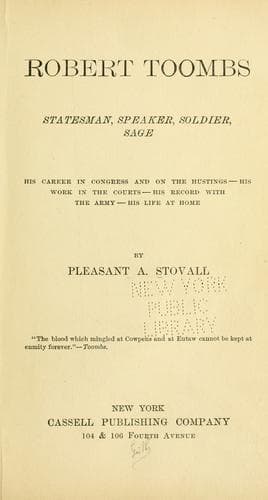
Robert Toombs: Statesman, Speaker, Soldier, SageStovall, Pleasant A.
History
Robert Toombs: Statesman, Speaker, Soldier, Sage
Stovall, Pleasant A.
Toombs, Robert Augustus, 1810-1885
The great contest of 1856 was coming on. A President was to be chosen.
The relations of the sections were more strained every day. The
elections of 1854 had emboldened the antislavery men to form the
Republican party, and to put out, as their candidate, John C. Fremont,
"pioneer and pathfinder," who had saved California to the Union. Fremont
was not a statesman, but a hero of the kind who dazzled men, and was
thought to be especially available as a presidential candidate. "Free
soil, Free men, Fremont" was the cry, and it was evident that the
Abolitionists had swept all the wavering Whigs into their lines and
would make a determined fight. The American party nominated Millard
Fillmore, and the Democracy, with a wealth of material and a
non-sectional following, wheeled into line. President Pierce was willing
to succeed himself. Stephen A. Douglas, who had rushed into the
convention of 1852 with such reckless dash to put aside "the old fogies"
of the party, was an avowed candidate. His championship of the
Kansas-Nebraska bill had made him a favorite in the South, although it
injured his chances at the North. It is not a little remarkable that
Douglas, whose candidacy had the effect of setting aside Buchanan for
Pierce in 1852, should afterward have been the means of turning down
Pierce for Buchanan.
James Buchanan of Pennsylvania had just returned from London, where he
had served with dignity as American Minister. Free from recent
animosities, he entered the field, fresh and full of prestige. He was
nominated for President on the fifth day of the Democratic Convention,
Georgia casting her vote for him. The Cincinnati platform adopted this
plank:
"_Resolved_: That we recognize the right of the people of the
Territories, including Kansas and Nebraska, acting through the legally
and fairly expressed will of a majority of the actual residents, and
whenever the number of their inhabitants justifies it, to form a
Constitution, either with or without domestic slavery, and to be
admitted into the Union upon terms of perfect equality with all the
other States."
Public-domain text, read in full here on John Shaqi.
Reviews
Reviews
No reviews yet
Be the first to share your thoughts on this work.
Elsewhere in the archive
Join the Discussion
Join the discussion
Sign in to leave a comment or review.
Sign InorCreate an account