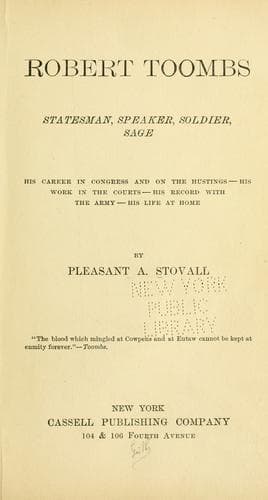
Robert Toombs: Statesman, Speaker, Soldier, SageStovall, Pleasant A.
History
Robert Toombs: Statesman, Speaker, Soldier, Sage
Stovall, Pleasant A.
Toombs, Robert Augustus, 1810-1885
The license is signed by William H. Crawford, Judge, Superior Court,
Northern Circuit. Judge Crawford had served two terms in the United
States Senate from Georgia. He had been Minister to Paris during the
days of the first Napoleon. He had been Secretary of War and of the
Treasury of the United States. In 1825 he received a flattering vote for
President, when the Clay and Adams compact drove Jackson and Crawford to
the rear. Bad health forced Mr. Crawford from the field of national
politics, and in 1827, upon the death of Judge Dooly, Mr. Crawford was
appointed Judge of the Northern Circuit. He held this position until his
death in Elbert County, which occurred in 1834. Crawford was a friend
and patron of young Toombs. The latter considered him the full peer of
Webster and of Calhoun.
Robert Toombs was married eight months after his admission to the bar.
His career in his profession was not immediately successful. A newspaper
writer recently said of him that "while his contemporaries were fighting
stubbornly, with varying luck, Toombs took his honors without a
struggle, as if by divine right." This was no more true of Toombs than
it is true of other men. He seems to have reached excellence in law by
slow degrees of toil. Hon. Frank Hardeman, Solicitor-General of the
Northern Circuit, was one of the lawyers who examined Toombs for
admission to the bar. He afterward declared that Robert Toombs, during
the first four or five years of his practice, did not give high promise.
His work in his office was spasmodic, and his style in court was too
vehement and disconnected to make marked impression. But the exuberance
or redundancy of youth soon passed, and he afterward reached a height in
his profession never attained by a lawyer in Georgia.
His work during the first seven years of his practice did not vary in
emolument or incident from the routine of a country lawyer. In those
days the bulk of legal business lay in the country, and the most
prominent men of the profession made the circuit with their saddle-bags,
and put up during court week at the village taverns. Slaves and land
furnished the basis of litigation. Cities had not reached their size and
importance, corporations had not grown to present magnitude, and the
wealth and brains of the land were found in the rural districts. "The
young lawyers of to-day," says Judge Reese of Georgia, "are far in
advance of those during the days of Toombs, owing to the fact that
questions and principles then in doubt, and which the lawyers had to dig
out, have been long ago decided, nor were there any Supreme Court
reports to render stable the body of our jurisprudence."
Public-domain text, read in full here on John Shaqi.
Reviews
Reviews
No reviews yet
Be the first to share your thoughts on this work.
Join the Discussion
Join the discussion
Sign in to leave a comment or review.
Sign InorCreate an account