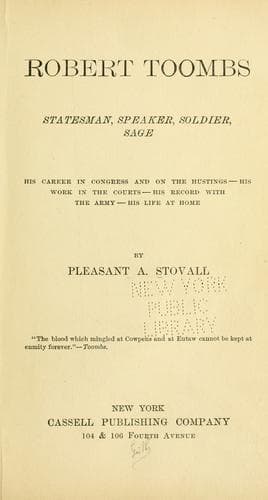
Robert Toombs: Statesman, Speaker, Soldier, SageStovall, Pleasant A.
History
Robert Toombs: Statesman, Speaker, Soldier, Sage
Stovall, Pleasant A.
Toombs, Robert Augustus, 1810-1885
He was rather an ill-ordered growth of the early West, a man who had
toiled and suffered from his youth up. He was full of sharp corners and
rough edges, and his nature was a strange mixture of patience and
melancholy. As Mr. Stephens said, he regarded slavery "in the light of a
religious mysticism," and believed that his mission to beat it down was
God-ordained. And yet he was a statesman, a public man of breadth and
prominence, a speaker of force and persuasion. He had the robust courage
of a pioneer and the high purpose of a reformer. It was in this debate
that Mr. Lincoln, at Freeport, Ill., asked Mr. Douglas that memorable
question, on the stump: "Can the people of a Territory, in any lawful
way, exclude slavery from their limits, prior to the formation of a
State constitution?" Mr. Douglas promptly answered, "Yes." This was his
doctrine of popular sovereignty. But the answer cost him the Democratic
nomination to the Presidency. The theory that a mass of settlers,
squatting in a Territory, could fix and determine the character of the
Territory's domestic institutions, was repugnant to a large portion of
the Southern people. They claimed that under the Dred Scott decision,
slavery already existed in the Territories, and must be protected by the
Constitution; and that it was not competent for the people to determine
for themselves the question of slavery or no slavery, until they formed
a constitution for admission into the Union as a State.
The election in Illinois, in the fall of 1858, gave Stephen A. Douglas a
majority of eight in the General Assembly over Abraham Lincoln, and
Douglas was reelected for the new term. In this contest he had been
opposed by the Buchanan Democrats, who cast over 8000 votes in Illinois.
In the Senate, the debate on popular sovereignty was renewed. This time
Jefferson Davis, a senator from Mississippi, attacked this position as
incompatible with the Constitution and the laws. Mr. Davis was a
skillful debater. His mind was singularly graceful and refined. He was
eloquent, logical, and courageous. His career as soldier and statesman,
as War Minister under Pierce, and as senator for Mississippi, made him a
prominent figure. He was cultured, classical, and well rounded, equipped
by leisure and long study for the career before him. He had vanquished
Sergeant S. Prentiss in public discussion over the national bank, and
contested, inch by inch, the domination of Henry S. Foote in
Mississippi. His career in the Mexican war had been a notable one.
Allied to Zachary Taylor by marriage, a West Pointer by training, a
Southern planter by occupation, he was a typical defender of slavery as
it existed. Davis was as slender and frail as Douglas was compact and
sinewy. Like Lincoln, his mind grasped great principles, while Douglas
was fighting for points and expedients.
Public-domain text, read in full here on John Shaqi.
Reviews
Reviews
No reviews yet
Be the first to share your thoughts on this work.
Elsewhere in the archive
Join the Discussion
Join the discussion
Sign in to leave a comment or review.
Sign InorCreate an account