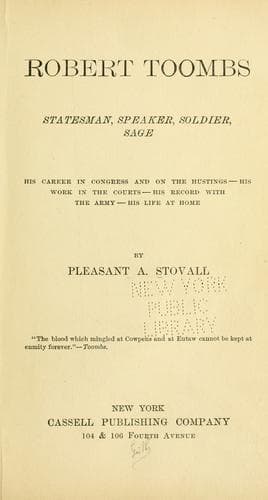
Robert Toombs: Statesman, Speaker, Soldier, SageStovall, Pleasant A.
History
Robert Toombs: Statesman, Speaker, Soldier, Sage
Stovall, Pleasant A.
Toombs, Robert Augustus, 1810-1885
Douglas declared that the territorial settler could determine whether
slavery should exist, by his influence in providing or withholding
police power; although he denied the constitutional right to legislate
slavery out of the Territories, yet he believed the "popular sovereign"
could, by means of "unfriendly legislation," bar out the Southern
settler with his slaves. It was not difficult for Mr. Davis to impale
him upon this plea.
Senator Douglas had saved his seat in the Senate, but his position in
the Democratic party was weakened. The Lecompton Constitution passed the
Senate in spite of Douglas's steady opposition.
Senator Toombs took no part in the subtleties of the Douglas-Davis
debate. He listened to the refinements of that discussion with decided
convictions of his own, but with clear appreciation of the fact that
every point scored against Douglas was cleaving the Democratic party in
twain. Mr. Toombs favored the adoption of the Lecompton Constitution,
but when it was rejected by the House, he promptly accepted the English
compromise, to refer the matter back to the people. Mr. Toombs had
always been partial to Douglas. In the campaign of 1856 he declared, in
Georgia, that "the man who condemned Senator Douglas needed watching
himself." He viewed with some pain the Douglas departure over popular
sovereignty; indeed he once declared that had he not been called away
from the Senate for quite a time in 1856, Mr. Douglas would never have
gone off on this tangent. When asked if Douglas were really a great
man, Senator Toombs, in 1860, answered with characteristic heartiness
and exaggeration, "There has been but one greater, and he, the Apostle
Paul."
It was very evident that the people of the South would demand new
guarantees for the protection of slavery against the dogma of popular
sovereignty. The platform of the Cincinnati convention, upon which
Buchanan had been elected, must be recast. The platform had declared
that immigrants to any part of the public domain were to settle the
question of slavery for themselves. The new plank, which President
Buchanan framed, was that the government of a Territory was provisional
and temporary, and during its existence, all citizens of the United
States had an equal right to settle with their property in the
Territory, without their rights, either of person or property, being
destroyed or impaired by Congressional or Territorial legislation. The
two last words contained the gist of the resolution, which was aimed at
Senator Douglas. However right as an abstract principle, Mr. Stephens
declared that this was a departure from the doctrine of
non-intervention.
It was at this time that Senator Toombs made one of the most important
speeches of his life. This was delivered in Augusta, Ga., September 8,
1859, during an exciting campaign. Governor Brown was a candidate for
reelection, and a strong opposition party had developed in Georgia,
representing the extreme Southern sentiment.
Public-domain text, read in full here on John Shaqi.
Reviews
Reviews
No reviews yet
Be the first to share your thoughts on this work.
Elsewhere in the archive
Join the Discussion
Join the discussion
Sign in to leave a comment or review.
Sign InorCreate an account