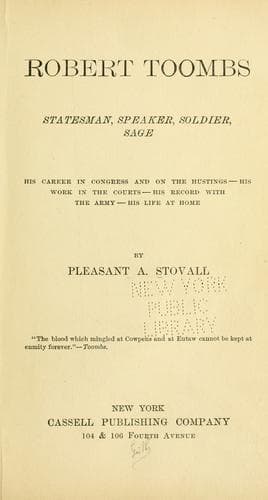
Robert Toombs: Statesman, Speaker, Soldier, SageStovall, Pleasant A.
History
Robert Toombs: Statesman, Speaker, Soldier, Sage
Stovall, Pleasant A.
Toombs, Robert Augustus, 1810-1885
At that time there were thirty-three States in the Union. The committee
on platform consisted of one from each State. The delegates from
California and Oregon, voting with the South, gave them seventeen votes
in committee. The resolutions were quickly framed, with the exception of
the one on slavery. Here was the deadlock. The majority plank declared
that the right to settle in the Territories with slaves "was not to be
destroyed nor impaired by Territorial legislation." The minority
proposed once more to leave the question to the Supreme Court. The
compromise was not accepted. The two reports came before the convention,
and, the Douglas men being in the majority on the floor, the minority,
or squatter-sovereignty report, was adopted by a vote of 165 to 138.
Here came the crisis. The delegates from Alabama, Mississippi, Florida,
Louisiana, Arkansas, Texas, and a part of Delaware, withdrew from the
convention. Hon. William L. Yancey of Alabama led this movement. He was
a man of courage and decision, with unrivaled powers of oratory. He had
been a member of Congress, and his influence in the South was large. So
far back as June 15, 1858, he had written a famous letter to James M.
Slaughter that "no national party can save us; no sectional party can
ever do it; but if we would do as our fathers did, organize committees
of safety all over the cotton States--and it is only to them that we can
hope for any effectual movement--we shall fire the Southern heart,
instruct the Southern mind, give courage to each other, and, by one
concerted action, we can precipitate the cotton States into a
revolution." This was called the "Scarlet Letter," and was widely
scattered and read.
The seceding delegates organized a second assemblage over which the Hon.
James A. Bayard presided. The Douglas men were left in control of the
first convention, but could not secure the two-thirds vote necessary for
his nomination. More than fifty ballots were taken, the full strength of
the Illinois candidate being 152. On the 3d of May the convention
adjourned to meet in Baltimore on the 18th of June, when it was hoped a
spirit of compromise might be inspired by the seriousness of the
situation.
On the night of the break in that body Mr. Yancey made a speech in
Charleston, when in prophetic words he declared, "Perhaps even now the
pen of the historian is nibbed to inscribe the history of a new
revolution."
The seceding delegates called for a convention to be held in Richmond,
Va., on the second Monday in June.
Public-domain text, read in full here on John Shaqi.
Reviews
Reviews
No reviews yet
Be the first to share your thoughts on this work.
Elsewhere in the archive
Join the Discussion
Join the discussion
Sign in to leave a comment or review.
Sign InorCreate an account