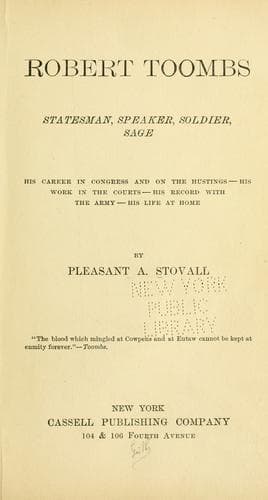
Robert Toombs: Statesman, Speaker, Soldier, SageStovall, Pleasant A.
History
Robert Toombs: Statesman, Speaker, Soldier, Sage
Stovall, Pleasant A.
Toombs, Robert Augustus, 1810-1885
When the seven States had withdrawn from the convention, the Georgia
delegation was split up. A majority left the convention, a small
minority remained. This action created great excitement in Georgia. The
Democratic executive committee called a State convention to meet in
Milledgeville on June 4. A committee of prominent citizens, headed by
Hon. J. J. Gresham of Macon, addressed letters to public men asking
their views in this alarming situation. Howell Cobb indorsed the
seceders; he was opposed to Douglas. Alexander H. Stephens thought
Georgia should appoint delegates to the Baltimore convention, withdraw
the demand for a new plank in the Cincinnati platform, abide by the
doctrine of non-intervention, and nominate a good man for President. "If
we must quarrel with the North," said he, "let us base it on the
aggressive acts of our enemies and not on the supposed shortcomings of
our friends."
Hon. Robert Toombs did not come South during the Charleston convention.
He watched from his post in the Senate the great struggle between the
Democratic factions. On May 10, he wrote, in reply to the letter of the
Macon committee:
Perhaps the time may not have come for the attainment of
the full measure of our constitutional rights; it may not
have been prudent on the part of the representatives of the
seventeen States to have sanctioned and presented as much
truth on the slavery issue as is contained in what is
commonly called the majority platform; but when it was thus
sanctioned, approved, and presented to the convention, it
was well to stand by and defend it, especially against the
platform of the minority. The seceding delegates did this
with manly firmness, and I approve their action.
Mr. Toombs advised, however, that the seceding delegates ought to meet
with the convention at Baltimore and endeavor to obtain such a
satisfactory adjustment of difficulties as could be secured. "This
course requires no sacrifice of principles." This plan had been proposed
by the delegates from New York to the delegates from the Southern
States. "The proposed Richmond convention, if it shall be found
necessary to hold it," he said, "can be held after, as well as before
the Baltimore convention, and I think with clearer lights for its
guidance."
"It is sometimes wise," said Mr. Toombs, "to accept a part of our just
rights, if we can have the residue unimpaired and uncompromised, but
nothing can justify a voluntary surrender of principle, indispensable to
the safety and honor of the State.
Public-domain text, read in full here on John Shaqi.
Reviews
Reviews
No reviews yet
Be the first to share your thoughts on this work.
Elsewhere in the archive
Join the Discussion
Join the discussion
Sign in to leave a comment or review.
Sign InorCreate an account