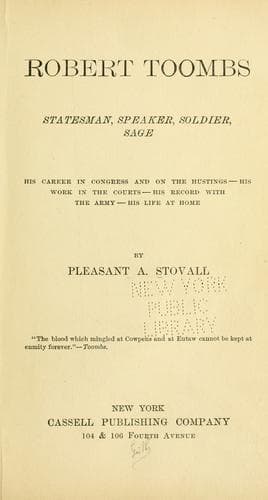
Robert Toombs: Statesman, Speaker, Soldier, SageStovall, Pleasant A.
History
Robert Toombs: Statesman, Speaker, Soldier, Sage
Stovall, Pleasant A.
Toombs, Robert Augustus, 1810-1885
"It is true we are surrounded with danger, but I do not concur in the
opinion that the danger to the Union is even one of our greatest perils.
The greatest danger, to-day, is that the Union will survive the
Constitution. The body of your enemies in the North, who hate the
Constitution, and daily trample it under their feet, profess an ardent
attachment to the Union, and I doubt not, feel such attachment for a
Union unrestrained by a Constitution. Do not mistake your real danger!
The Union has more friends than you have, and will last, at least, as
long as its continuance will be compatible with your safety."
Prior to the reassembling of the Democratic convention, the resolutions
introduced by the Hon. Jefferson Davis, containing the Southern
exposition of principles, came up in the Senate. Mr. Toombs had opposed
the policy of introducing those resolutions, but as they were then
before the country, he said they should be met. He ridiculed the idea of
popular sovereignty. He declared that Congress should protect slavery in
the Territories. The Federal Government, he claimed, did protect its
citizens, native and naturalized, at home and abroad, everywhere except
on the soil of our own territory, acquired by common blood and treasure.
This speech of Senator Toombs marked an epoch in his career. It
separated him entirely from Stephen A. Douglas, to whom he had been
closely allied, in spite, as he said, of Douglas having wandered after
strange gods. Douglas absented himself from the Senate when Toombs
spoke. For the first time in twenty years, Toombs and Stephens took
divergent paths. They were called in Georgia the "Siamese twins." From
the election of Harrison to the Democratic split in 1860, they had been
personal friends and firm political allies. Mr. Stephens was for Douglas
and the Union; Mr. Toombs feared lest "the Union survive the
Constitution."
The Democratic party in Georgia met on June 4, and parted on the lines
of the Charleston division. The Union element in Georgia was led by
Herschel V. Johnson, a man of power and influence. He had been Governor
of the State, was a man of learning, profound in thought and candid in
expression. His wife was a niece of President Polk. His state papers
were models of clear and classical expression. Governor Johnson was,
however, better fitted for the bench or the Cabinet than for a public
leader.
Public-domain text, read in full here on John Shaqi.
Reviews
Reviews
No reviews yet
Be the first to share your thoughts on this work.
Elsewhere in the archive
Join the Discussion
Join the discussion
Sign in to leave a comment or review.
Sign InorCreate an account