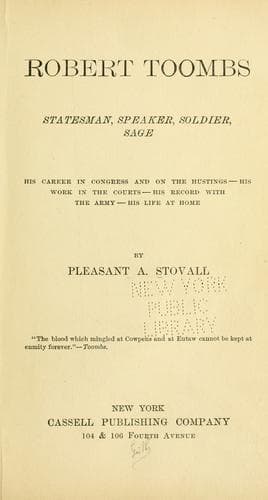
Robert Toombs: Statesman, Speaker, Soldier, SageStovall, Pleasant A.
History
Robert Toombs: Statesman, Speaker, Soldier, Sage
Stovall, Pleasant A.
Toombs, Robert Augustus, 1810-1885
Senator Toombs, while a member of the Georgia Legislature, opposed the
omnibus bill, granting State aid to railroads, and one of the first
devices to fall under his criticism was a scheme to build a road to his
own town. He was by nature progressive. He championed the cause of the
State railroad of Georgia. In general terms he believed that the States
and the people should carry out works of internal improvement. It is
said that the first office ever held by Mr. Toombs was that of
commissioner of the town of Washington, Ga. The election hinged upon a
question of public improvement, the question being "ditch or no ditch";
Toombs was elected commissioner, and the ditch was dug.
He was nothing of a demagogue. He did not attempt to belittle the public
service. He championed the provision for higher pay for the United
States Judges, and for increasing the stipend of army officers, although
he denounced the system of double rations as vicious. He did not
hesitate to hit an unnecessary expense in every shape. All overflowing
pension grabs found in him a deadly enemy. In December, 1856, while
speaking on the subject of claims, he said: "In 1828, when half a
century had passed over the heads of the men who fought your battles,
when their generation was gone, when Tories and jobbers could not be
distinguished from the really meritorious, the agents came here and
attempted to intimidate public men." He alluded to pension agents as men
who prowl about and make fortunes by peddling in the pretended
patriotism and sufferings of their fathers.
"It is," said he, "a poor pretext for an honorable man to come and tell
the government, 'My ancestor fought for his own and the public liberty;
he did not choose to be a slave to a foreign despotism; but with
manliness, and honor, and patriotism, he fought during the war; now pay
me for this. I want to be paid in hard dollars for the honor, and
chivalry, and patriotism of my ancestor.' I tell you, Mr. President, it
is not good money; it is bad money; it is dishonorable to the memory of
those who fought your battles."
In February, 1857, the electoral vote for President was counted by the
two Houses of Congress. The vote of the State of Wisconsin (five
ballots) had been cast on a day other than that fixed by the States for
the meeting of the Electoral College. If counted, it gave Fremont 114
votes; if omitted, Fremont would have 109.
Public-domain text, read in full here on John Shaqi.
Reviews
Reviews
No reviews yet
Be the first to share your thoughts on this work.
Elsewhere in the archive
Join the Discussion
Join the discussion
Sign in to leave a comment or review.
Sign InorCreate an account