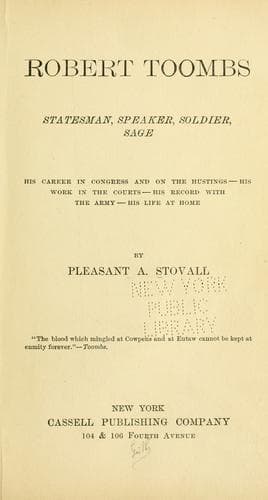
Robert Toombs: Statesman, Speaker, Soldier, SageStovall, Pleasant A.
History
Robert Toombs: Statesman, Speaker, Soldier, Sage
Stovall, Pleasant A.
Toombs, Robert Augustus, 1810-1885
In the debate which followed, Senator Toombs discussed very closely a
point which has since been the subject of sharp contention. He said:
"The duty of counting the vote for President devolves on the Senate and
House of Representatives. They must act in their separate capacities;
but they alone can determine it, and not the President of the Senate and
the tellers of the two Houses. It is a high privilege, a dangerous one
to the liberties and Constitution of this country. The Senate and House
must determine the votes to be counted, and the President of the Senate
can only announce those to be votes which are thus decided by competent
authority, and any attempt of the presiding officer to declare what
votes he may deem to be legal, or to decide which are the votes, no
matter whether it affects the result or not, or even to say that the
question shall not be decided, however highly I respect the chair, I
submit is not a power given to the presiding officer by the Constitution
and the laws."
In 1850 Senator Toombs found it necessary to oppose an appropriation for
an experiment with the Atlantic cable. He was not prepared to say that
the experiment would not be successful, but he boldly declared, despite
the importance of the work and the high character of the men who were
supporting it, that there was no power in the Federal Constitution for
such an appropriation. Because the government establishes post roads, it
could not be inferred that the government had the power to aid in
transmitting intelligence to all quarters of the globe. He did not
believe in going beyond the constitutional guarantees. He declared of
these questions, as he had in the debate upon the Kansas bill, that in
hunting for power and authority he knew but one place to go--to the
Constitution. When he did not find it there, he could not find it
anywhere.
Senator Toombs favored the purchase of Cuba, because he considered it
advantageous to the republic. "I will accept Canada as readily, if it
can be honestly and fairly done," he said. "I will accept Central
America and such part of Mexico as, in my judgment, would be
advantageous to the republic."
Public-domain text, read in full here on John Shaqi.
Reviews
Reviews
No reviews yet
Be the first to share your thoughts on this work.
Elsewhere in the archive
Join the Discussion
Join the discussion
Sign in to leave a comment or review.
Sign InorCreate an account