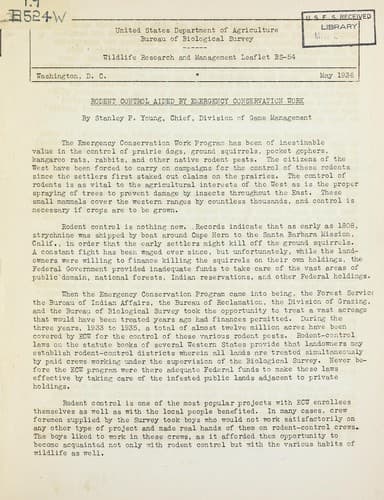
Rodent Control Aided by Emergency Conservation WorkYoung, Stanley Paul
Science
Rodent Control Aided by Emergency Conservation Work
Young, Stanley Paul
Pests -- Control; Rodents -- Control
Kangaroo rats abound on millions of acres of desert and semidesert
range and farm lands. On ranges that have been overgrazed, kangaroo
rats must be controlled before reseeding can be accomplished, as they
gather and store practically all of the seed within a radius of 100
yards from their burrows.
[Illustration: Close-up of typical kangaroo rat den.]
[Illustration: Showing plot protected from both livestock and kangaroo
rats.]
[Illustration: Plot showing grazing by kangaroo rats--livestock being
excluded.]
[Illustration: Area on left of fence subject to grazing by both
livestock and kangaroo rats. On right of fence shows protection from
both livestock and rodents.]
[Illustration: Open range--note lack of native grasses.]
[Illustration: Kangaroo rat den around mesquite bush. Note lack of
vegetation.]
[Illustration: Typical kangaroo rat infestation.]
[Illustration: Trail leading from kangaroo rat den to feeding ground.]
[Illustration: Close-up of feeding ground. Note rat pellets and close
cropped grass.]
[Illustration: Kangaroo rat den before excavating,]
[Illustration: Cross section of den, showing storage chambers and
stored grass seeds.]
[Illustration: Seed heads taken from one kangaroo rat den--
A--Burrow grass seed.
B--Indian wheat heads.
C--Weed seeds.
D--Unidentified grass heads.]
[Illustration: Kangaroo rat den before treatment (July 1, 1935), Papago
Indian Reservation, Sells, Arizona.]
[Illustration: Same location as above two months later after
eliminating the kangaroo rats.]
RABBITS AND HARES
Reforestation is greatly hampered by rabbits in cut-over areas where
intermittent fires have killed all seedlings over a period of years. In
many areas the snowshoe hare will eat off as many as 40 percent of the
seedlings and damage up to 70 percent of them.
[Illustration: Rabbit-infested reforestation area--Olympic National
Forest, Washington.]
[Illustration: Damage to jackpine caused by snowshoe hares--Dukes,
Michigan.]
[Illustration: Healthy Norway pine. Snowshoe hare damage to pine and
spruce seedlings at this stage of growth consists of nipping the
terminal bud.]
[Illustration: Spruce tree with lateral branches removed by snowshoe
hares--Price County, Wisconsin.]
[Illustration: Typical damage to cornfield by jack rabbits--Texas.]
PORCUPINES
On many national forest areas the control of porcupines is imperative
from the standpoint of timber reproduction. This is especially true on
cut-over areas and where fires have destroyed all seedlings. Porcupines
will often destroy up to 90 percent of the seedlings and, through
continued girdling of young trees 15 to 25 years of age, will destroy
all chance for commercial timber for many years to come.
[Illustration: Typical porcupine den. Picture taken on Pike National
Forest in Colorado, in area where porcupine control work was conducted
under the Forest Service E.C.W. program.]
[Illustration: Porcupine at work girdling pine tree.]
Public-domain text, read in full here on John Shaqi.
Reviews
Reviews
No reviews yet
Be the first to share your thoughts on this work.
Join the Discussion
Join the discussion
Sign in to leave a comment or review.
Sign InorCreate an account