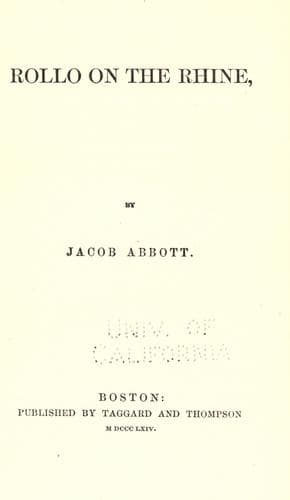
Rhineland (Germany) -- Description and travel -- Juvenile literature
It was to one of these hotels at Rolandseck that the porter at Bonn had
arranged to send Mr. George, as the pleasantest place that was near to
spend the Sabbath in. He could not have made a better selection.
The ride, too, in the carriage from Bonn up to Rolandseck, was
delightful. Nothing could be more enchanting than the scenery which was
presented to view on every hand. The carriage, like all the other
private carriages used for travellers on the Rhine, was an open
barouche, and when the top was down it afforded an entirely unobstructed
view. The day was pleasant, and yet the sun was so obscured with clouds
that it was not warm, and Rollo stood up in the carriage nearly all the
way, supporting himself there by taking hold of the back of the driver's
seat, and looking about him on every side, uttering continual
exclamations of wonder and delight. He attempted once or twice to talk
with the driver, trying him in French and English; but the driver
understood nothing but German, and so the conversation soon settled down
to an occasional _Was ist das?_ from Rollo, and a long reply to the
question from the driver, not a word of which Rollo was able to
understand.
They passed out of Bonn by means of a most singular avenue. It was
formed of a very broad space in the centre, which seemed, by its place,
to have been intended for the road way; but instead of being a road way,
it was covered with a rich growth of grass, like a mowing field. On
each side of this green were two rows of trees, which bordered a sort of
wide sidewalk, of which there were two, one on each side of the road.
These side passages were the carriage ways.
"See, uncle George," said Rollo. "The road has all grown up to grass,
and we are riding on the sidewalk."
The carriage passed on, and when it reached the end of the avenue, it
came to a beautiful and extensive edifice, standing in the midst of
groves and gardens, which was formerly a chateau, but is now used for a
museum of natural history. Here were arranged the cabinets which Mr.
George had been to see that morning. Passing this place, the carriage
gradually ascended a long hill, on the summit of which, half concealed
by groves of trees, was an ancient-looking church. Mr. George had seen
this hill before from the windows of the hotel, and knew it must be the
Kreitzberg.
"He is taking us to the Kreitzberg," said Mr. George.
"What is that famous for?" asked Rollo.
"It is an ancient church, on the top of a high hill," said Mr. George,
"where there is a flight of stairs made to imitate those that Jesus
ascended at Jerusalem, when he went to Pilate's judgment hall. Nobody
is allowed to go up or down these stairs except on their knees.
Public-domain text, read in full here on John Shaqi.
Reviews
Reviews
No reviews yet
Be the first to share your thoughts on this work.
Join the Discussion
Join the discussion
Sign in to leave a comment or review.
Sign InorCreate an account