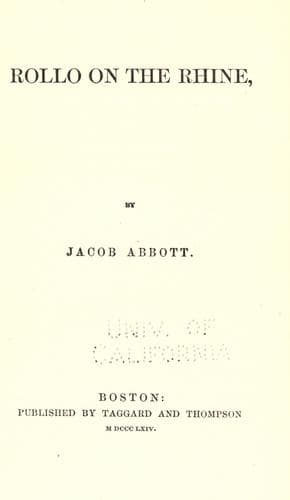
Rhineland (Germany) -- Description and travel -- Juvenile literature
"Thus you see," continued Mr. George, "that for all that the people come
for, to such a service as that, it was not necessary that they should
hear at all. There was not any thing to be _said to_ them. There was
only something to be _done for_ them; and so long as it was done, and
done properly, they standing by and consenting, it was not of much
consequence whether they could see and hear or not. So the priest turned
his face away from them towards the altar; and when he had any thing to
say, he spoke the words in a very low and inaudible voice."
"It is impossible," said Rollo, after a short pause, "that the wine
should become blood, and the wafer flesh, while they yet look just as
they did before."
[Illustration: THE EMIGRANTS.]
"True," said Mr. George, "it seems impossible to us, who hear of it for
the first time, after we have grown up to years of discretion; but that
does not prevent its being honestly believed by people that have been
taught to consider it true from their earliest infancy."
"Do you suppose the priests themselves believe it?" asked Rollo.
"Yes," said Mr. George, "a great many of them undoubtedly do. We find,
it is true, every where, that the most intelligent and well educated men
will continue, all their lives, to believe very strange things, provided
they were taught to believe them when they were very young; and
provided, also, that their worldly interests are in any way concerned in
their continuing to believe them."
Just at this time, Rollo's attention was attracted to what seemed to be
an encampment on the roadside at a little distance before them. It was a
family of emigrants that were going down the river, and had stopped to
rest. The horses had been unharnessed, and were eating, and the wagon
was surrounded with a family consisting of men, women, and children, who
were sitting on the bank taking their suppers. Rollo wished very much
that he understood German, so as to go and talk with them. But he did
not, and so he contented himself with wishing them _guten abend_, which
means good evening, as he went by.
He went on after this, without any farther adventure, to the village,
and after attending church there, he returned with his uncle down along
the bank of the river to the hotel.
[Illustration]
CHAPTER IX.
EHRENBREITSTEIN.
The people of the Rhine have not allowed all the old castles to go to
ruin. Some have been carefully preserved from age to age, and never
allowed to go out of repair. Others that had gone to decay, or had been
destroyed in the wars, have been repaired and rebuilt in modern times,
and are now in better condition than ever.
Public-domain text, read in full here on John Shaqi.
Reviews
Reviews
No reviews yet
Be the first to share your thoughts on this work.
Join the Discussion
Join the discussion
Sign in to leave a comment or review.
Sign InorCreate an account