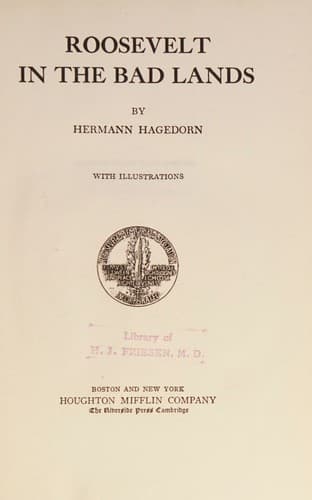
Biography; Frontier and pioneer life -- Dakota Territory; Roosevelt, Theodore, 1858-1919
After a brief sojourn at the Maltese Cross, Roosevelt made his way
north to Elkhorn Ranch. The house was nearing completion. It was a
one-story log structure, with a covered porch on the side facing the
river; a spacious house of many rooms divided by a corridor running
straight through from north to south. Roosevelt's bedroom, on the
southeast corner, adjoined a large room containing a fireplace, which
was to be Roosevelt's study by day and the general living-room by
night. The fireplace, which had been built by an itinerant Swedish
mason whom Sewall looked upon with disapproval as a dollar-chaser, had
been designed under the influence of a Dakota winter and was enormous.
Will Dow, who was somewhat of a blacksmith, had made a pair of
andirons out of a steel rail, which he had discovered floating down
the river loosely attached to a beam of yellow pine.[10]
[Footnote 10: The andirons are still doing service at
the ranch of Howard Eaton and his brothers in Wolf,
Wyoming.]
The cattle, Roosevelt found, were looking well. "Bill," he said to
Sewall, remembering the backwoodsman's pessimism, "you were mistaken
about those cows. Cows and calves are all looking fine."
But Sewall was not to be convinced. "You wait until next spring," he
answered, "and see how they look."
Roosevelt was himself physically in rather bad shape, suffering from
that affliction which has, by common consent, been deemed of all of
Job's troubles the one hardest to bear with equanimity. Douglas
Robinson wrote Sewall telling him that Theodore's sisters were worried
about him and asking him for news of Roosevelt's health. Roosevelt
heard of the request and was indignant, "flaring up," as Sewall
described it.
"They had no business to write to you," he exclaimed. "They should
have written to me."
"I guess," remarked Sewall quietly, "they knew you wouldn't write
about how you were getting on. You'd just say you were all right."
Roosevelt fumed and said no more about it. But the crisp air of the
Bad Lands gradually put all questions of his health out of mind. All
day long he lived in the open. He was not an enthusiast over the
hammer or the axe, and, while Sewall and Dow were completing the house
and building the corrals and the stables a hundred yards or more
westward, he renewed his acquaintance with the bizarre but fascinating
country. The horses which the men from Maine had missed the previous
autumn, and which Roosevelt had feared had been stolen, had been
reported "running wild" forty or fifty miles to the west. Sewall and
Dow had made one or two trips after them without success, for the
animals had come to enjoy their liberty and proved elusive. Roosevelt
determined to find them and bring them back. He went on three solitary
expeditions, but they proved barren of result. Incidentally, however,
they furnished him experiences which were worth many horses.
Public-domain text, read in full here on John Shaqi.
Reviews
Reviews
No reviews yet
Be the first to share your thoughts on this work.
Elsewhere in the archive
Join the Discussion
Join the discussion
Sign in to leave a comment or review.
Sign InorCreate an account