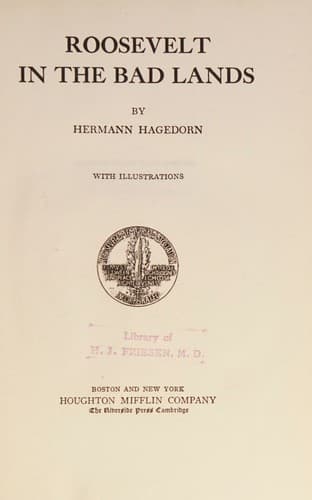
Biography; Frontier and pioneer life -- Dakota Territory; Roosevelt, Theodore, 1858-1919
The Ferrises and Merrifield were Canadians who had drifted west from
their home in New Brunswick and, coming out to the Dakota frontier two
years previous because the Northern Pacific Railroad carried emigrants
westward for nothing, had remained there because the return journey
cost five cents a mile. They worked the first summer as section hands.
Then, in the autumn, being backwoodsmen, they took a contract to cut
cordwood, and all that winter worked together up the river at Sawmill
Bottom, cutting timber. But Merrifield was an inveterate and skillful
hunter, and while Joe took to doing odd jobs, and Sylvane took to
driving mules at the Cantonment, Merrifield scoured the prairie for
buffalo and antelope and crept through the underbrush of countless
coulees for deer. For two years he furnished the Northern Pacific
dining-cars with venison at five cents a pound. He was a sure shot,
absolutely fearless, and with a debonair gayety that found occasional
expression in odd pranks. Once, riding through the prairie near the
railroad, and being thirsty and not relishing a drink of the alkali
water of the Little Missouri, he flagged an express with his red
handkerchief, stepped aboard, helped himself to ice-water, and rode
off again, to the speechless indignation of the conductor.
The three men had prospered in a small way, and while Joe turned
banker and recklessly loaned the attractive but unstable Johnny Nelson
a hundred dollars to help him to his feet, Sylvane and Merrifield
bought a few horses and a few head of cattle, took on shares a hundred
and fifty more, belonging to an old reprobate of a ranchman named
Wadsworth and a partner of his named Halley, and, under the shadow of
the bold peak that was a landmark for miles around, started a ranch
which they called the "Chimney Butte," and every one else called,
after their brand, the "Maltese Cross." A man named Bly who had kept a
hotel in Bismarck, at a time when Bismarck was wild, and had drifted
west with the railroad, was, that season, cutting logs for ties a
hundred and fifty miles south in the Short Pine Hills. He attempted
to float the timber down the river, with results disastrous to his
enterprise, but beneficial to the boys at Chimney Butte. A quantity of
logs perfectly adapted for building purposes stacked themselves at a
bend not an eighth of a mile from the center of their range. The boys
set them on end, stockade-fashion, packed the chinks, threw on a mud
roof, and called it "home."
Public-domain text, read in full here on John Shaqi.
Reviews
Reviews
No reviews yet
Be the first to share your thoughts on this work.
Join the Discussion
Join the discussion
Sign in to leave a comment or review.
Sign InorCreate an account