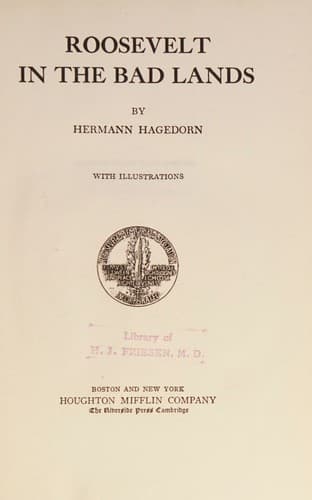
Biography; Frontier and pioneer life -- Dakota Territory; Roosevelt, Theodore, 1858-1919
I'd rather hear a rattler rattle,
I'd rather buck stampeding cattle,
I'd rather go to a greaser battle,
Than--
Than to--
Than to fight--
Than to fight the bloody In-ji-ans.
I'd rather eat a pan of dope,
I'd rather ride without a rope,
I'd rather from this country lope,
Than--
Than to--
Than to fight--
Than to fight the bloody In-ji-ans.
_Cowboy song_
All through that autumn of 1885, Roosevelt remained in the Bad Lands.
With his whole being he reveled in the wild and care-free life; but
the newspapers did not seem to be able to rise above the notion that
he was in Dakota for political purposes:
Mr. Theodore Roosevelt, it is rumored [remarked the Chicago
_Tribune_] has an eye on politics in Dakota, and is making
himself popular with the natives. He is bright, certainly,
but Mr. Roosevelt will find the methods in Dakota quite
different from those which gave him sudden prominence in New
York. There is a great deal of breeziness in a Dakota
convention, but it is not the breeziness of innocence. It is
high art. The number of gentlemen who are in training for
United States senatorships, when Dakota shall have acquired
admission, is not limited, and each and every aspirant can
pull a wire with a silent grace which is fascinating. If Mr.
Roosevelt really likes politics, he will enjoy himself in
Dakota.
If Roosevelt had any notion of entering the race for the senatorship
in Dakota, he has left no record of it. Howard Eaton spoke to him once
about it. He was interested and even a little stirred, it appeared, at
the possibility of representing the frontier in the United States
Senate as, half a century previous, Thomas H. Benton, of Tennessee,
whom he greatly admired, had represented it. But the thought failed to
take permanent hold of him. He was, moreover, thinking of himself in
those days more as a writer than as a politician.
The autumn was not without excitement. A small band of Indians began
here and there to set fire to the prairie grass, and before the
cattlemen realized what was happening, thousands of acres of winter
feed lay blackened and desolate.
Public-domain text, read in full here on John Shaqi.
Reviews
Reviews
No reviews yet
Be the first to share your thoughts on this work.
Elsewhere in the archive
Join the Discussion
Join the discussion
Sign in to leave a comment or review.
Sign InorCreate an account