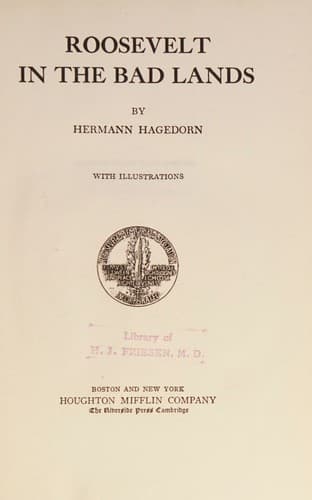
Biography; Frontier and pioneer life -- Dakota Territory; Roosevelt, Theodore, 1858-1919
This act of ruthless destruction was the climax of a war of reprisals
which had been carried on relentlessly between the Indians and the
white men since the first bold pioneer had entered the West Missouri
country. There was endless trouble and bad blood between the races,
which at intervals flared up in an outrage, the details of which were
never told in print because they were as a rule unprintable. In the
region between the Little Missouri and the Yellowstone, in the years
1884 and 1885, the wounds left by the wars, which had culminated in
the death of Custer at the Little Big Horn, were still open and sore.
In the conflict between white and red, the Indians were not always
the ones who were most at fault. In many cases the robberies and other
crimes which were committed were the acts of men maddened by
starvation, for the ranges where they had hunted had been taken from
them, and the reservations in many cases offered insufficient food.
The agents of the Great White Father, moreover, were not always
over-careful to give them all the cattle and the ponies which the
Government was by treaty supposed to grant them. In consequence they
"lifted" a cow or a calf where they could. The cattlemen, on their
part, thoroughly imbued with the doctrine of _might is right_,
regarded the Indians as a public enemy, and were disposed to treat
their ponies and any other property which they might possess as
legitimate prize of war. There was, in fact, during the middle
eighties, open and undisguised warfare between red and white
throughout the region whose eastern border was the Bad Lands. It was,
moreover, a peculiarly atrocious warfare. Many white men shot whatever
Indians they came upon like coyotes, on sight; others captured them,
when they could, and, stripping off their clothes, whipped them till
they bled. The Indians retaliated horribly, delivering their white
captives to their squaws, who tortured them in every conceivable
fashion, driving slivers up under their nails, burning them alive, and
feeding them with flesh cut from their own bodies. Along the banks of
the Little Missouri there were no outrages, for the Indians had been
driven out of the country at the end of the seventies, and, save for
occasional raids in the early eighties, had made little trouble; but
at the edge of the Bad Lands there was a skirmish now and then, and in
the winter of 1884 Schuyler Lebo, son of that odd Ulysses who had
guided Roosevelt to the Big Horn Mountains, was shot in the leg by an
Indian while he was hunting on Bullion Butte.
Public-domain text, read in full here on John Shaqi.
Reviews
Reviews
No reviews yet
Be the first to share your thoughts on this work.
Elsewhere in the archive
Join the Discussion
Join the discussion
Sign in to leave a comment or review.
Sign InorCreate an account