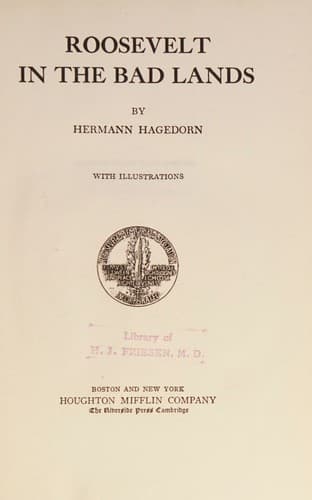
Biography; Frontier and pioneer life -- Dakota Territory; Roosevelt, Theodore, 1858-1919
Roosevelt had a little adventure of his own with Indians that summer.
He was traveling along the edge of the prairie on a solitary journey
to the unexplored country north and east of the range on which his
cattle grazed, and was crossing a narrow plateau when he suddenly saw
a group of four or five Indians come up over the edge directly in
front. As they saw him, they whipped their guns out of their slings,
started their horses into a run, and came toward him at full speed.
He reined up instantly and dismounted.
The Indians came on, whooping and brandishing their weapons.
Roosevelt laid his gun across the saddle and waited.
It was possible [Roosevelt wrote subsequently] that the
Indians were merely making a bluff and intended no mischief.
But I did not like their actions, and I thought it likely
that if I allowed them to get hold of me they would at least
take my horse and rifle, and possibly kill me. So I waited
until they were a hundred yards off and then drew a bead on
the first. Indians--and, for the matter of that, white
men--do not like to ride in on a man who is cool and means
shooting, and in a twinkling every man was lying over the
side of his horse, and all five had turned and were
galloping backwards, having altered their course as quickly
as so many teal ducks.
At some distance the Indians halted and gathered evidently for a
conference.
Thereupon one man came forward alone, making the peace sign first with
his blanket and then with his open hand. Roosevelt let him come to
within fifty yards. The Indian was waving a piece of soiled paper, his
reservation pass.
"How! Me good Injun," he called.
"How!" Roosevelt answered. "I'm glad you are. But don't come any
closer."
The Indian asked for sugar and tobacco. Roosevelt told him that he had
none. Another Indian now began almost imperceptibly to approach.
Roosevelt called to him to keep back, but the Indian paid no
attention.
Roosevelt whipped up his gun once more, covering the spokesman. That
individual burst into a volume of perfect Anglo-Saxon profanity; but
he retired, which was what he was supposed to do. Roosevelt led the
faithful Manitou off toward the plains. The Indians followed him at a
distance for two miles or more, but as he reached the open country at
last they vanished in the radiant dust of the prairie.
Public-domain text, read in full here on John Shaqi.
Reviews
Reviews
No reviews yet
Be the first to share your thoughts on this work.
Elsewhere in the archive
Join the Discussion
Join the discussion
Sign in to leave a comment or review.
Sign InorCreate an account