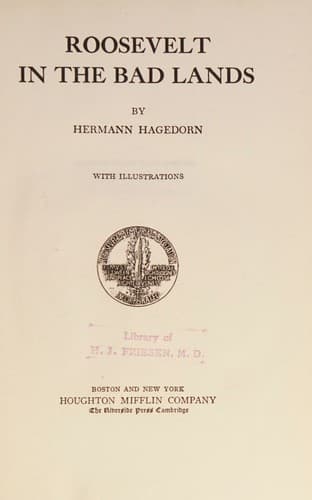
Biography; Frontier and pioneer life -- Dakota Territory; Roosevelt, Theodore, 1858-1919
He had an interesting story to tell. A year or less ago Henry
Gorringe, Abram S. Hewitt, of New York, and a noted London financier
named Sir John Pender, who had been instrumental in laying the first
successful Atlantic cable, had, in the course of a journey through the
Northwest, become interested in the cattle business and, in May, 1883,
bought the Cantonment buildings at Little Missouri with the object of
making them the headquarters of a trading corporation which they
called the Little Missouri Land and Stock Company. The details they
left to the enterprising naval officer who had proposed the scheme.
Gorringe had meanwhile struck up a friendship with Frank Vine. This
was not unnatural, for Frank was the social center of Little Missouri
and was immensely popular. What is almost incredible, however, is
that, blinded evidently by Frank's social graces, he took the genial
and slippery post-trader into the syndicate, and appointed him
superintendent. It was possibly because he did not concur altogether
in this selection that Pender sent Gregor Lang, who, owing to Lady
Pender's scruples, was without employment, to report to Gorringe in
New York and then proceed to Little Missouri.
What a somewhat precise Scotch Presbyterian thought of that
gathering-place of the wicked, the Presbyterian himself did not see
fit to divulge. He established himself at the Cantonment, set to work
with European thoroughness to find out all there was to find out about
the cattle business, and quietly studied the ways of Frank Vine. Those
ways were altogether extraordinary. Where he had originally come from
no one exactly knew. His father, whom the new superintendent promptly
established as manager of the Pyramid Park Hotel, had been a Missouri
steamboat captain and was regarded far and wide as a terror. He was,
in fact, a walking arsenal. He had a way of collecting his bills with
a cavalry saber, and once, during the course of a "spree," hearing
that a great Irishman named Jack Sawyer had beaten up his son Frank,
was seen emerging from the hotel in search of the oppressor of his
offspring with a butcher-knife in his boot, a six-shooter at his belt,
and a rifle in his hand. Frank himself was less of a buccaneer and was
conspicuous because he was practically the only man in Little Missouri
who did not carry arms. He was big-hearted and not without charm in
his nonchalant disregard of the moralities, but there was no truth in
him, and he was so foul-mouthed that he became the model for the youth
of Little Missouri, the ideal of what a foul-mouthed reprobate should
be.
"Frank was the darndest liar you ever knew," remarked, long after, a
man who had authority on his side. "And, by jinx, if he wouldn't
preface his worst lies with 'Now this is God's truth!'"
Public-domain text, read in full here on John Shaqi.
Reviews
Reviews
No reviews yet
Be the first to share your thoughts on this work.
Join the Discussion
Join the discussion
Sign in to leave a comment or review.
Sign InorCreate an account