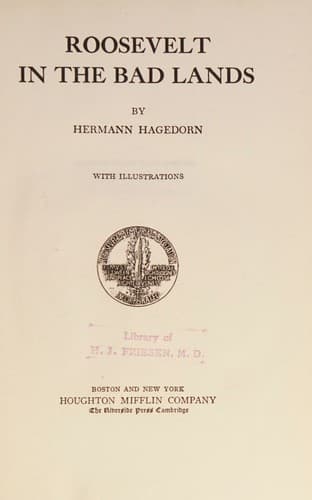
Biography; Frontier and pioneer life -- Dakota Territory; Roosevelt, Theodore, 1858-1919
When even the officers of the law were in league with the thieves or
afraid of them, there was little that the individual could do except
pocket his losses with as good grace as possible and keep his mouth
shut. The "system" tolerated no interference with its mechanism.
Fisher, smarting under the theft of six of the "top" horses from the
Marquis de Mores's "outfit" called one of the cowboys one day into his
office. His name was Pierce Bolan, and Fisher knew him to be not only
absolutely trustworthy, but unusually alert.
"You're out on the range all the time," said Fisher. "Can't you give
me a line on the fellows who are getting away with our horses?"
The cowboy hesitated and shook his head. "If I knew," he answered, "I
wouldn't dare tell you. My toes would be turned up the first time I
showed up on the range."
"What in ---- are we going to do?"
"Why, treat the thieves considerate," said Bolan. "Don't get 'em sore
on you. When one of them comes up and wants the loan of a horse, why,
let him have it."
Fisher turned to the foreman of one of the largest "outfits" for
advice and received a similar answer. The reputable stockmen were very
much in the minority, it seemed, and wise men treated the thieves with
"consideration" and called it insurance.
There were ranchmen, however, who were too high-spirited to tolerate
the payment of such tribute in their behalf, and too interested in the
future of the region as a part of the American commonwealth to be
willing to temporize with outlaws. Roosevelt was one of them, in the
valley of the Little Missouri. Another, across the Montana border in
the valley of the Yellowstone, was Granville Stuart.
Stuart was a "forty-niner," who had crossed the continent in a
prairie-schooner as a boy and had drifted into Virginia City in the
days of its hot youth. He was a man of iron nerve, and when the time
came for a law-abiding minority to rise against a horde of thieves and
desperadoes, he naturally became one of the leaders. He played an
important part in the extermination of the famous Plummer band of
outlaws in the early sixties, and was generally regarded as one of the
most notable figures in Montana Territory.
At the meeting of the Montana Stockgrowers' Association, at Miles City
in April, there had been much discussion of the depredations of the
horse and cattle thieves, which were actually threatening to destroy
the cattle industry. The officers of the law had been helpless, or
worse, in dealing with the situation, and the majority of the
cattlemen at the convention were in favor of raising a small army of
cowboys and "raiding the country."
Public-domain text, read in full here on John Shaqi.
Reviews
Reviews
No reviews yet
Be the first to share your thoughts on this work.
Elsewhere in the archive
Join the Discussion
Join the discussion
Sign in to leave a comment or review.
Sign InorCreate an account