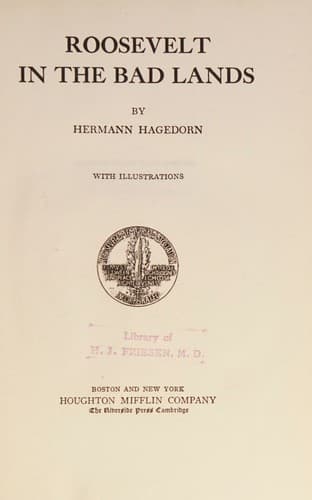
Biography; Frontier and pioneer life -- Dakota Territory; Roosevelt, Theodore, 1858-1919
Stuart, who was president of the Association, fought the project
almost single-handed. He pointed out that the "rustlers" were well
organized and strongly fortified, each cabin, in fact, constituting a
miniature fortress. There was not one of them who was not a dead shot
and all were armed with the latest model firearms and had an abundance
of ammunition. No "general clean-up" on a large scale could, Stuart
contended, be successfully carried through. The first news of such a
project would put the thieves on their guard, many lives would
unnecessarily be sacrificed, and the law, in the last analysis, would
be on the side of the "rustlers."
The older stockmen growled and the younger stockmen protested,
intimating that Stuart was a coward; but his counsel prevailed. A
number of them, who "stood in" with the thieves in the hope of thus
buying immunity, carried the report of the meeting to the outlaws. The
"rustlers" were jubilant and settled down to what promised to be a
year of undisturbed "operations."
Stuart himself, however, had long been convinced that drastic action
against the thieves must be taken; and had quietly formulated his
plan. When the spring round-up was over, late in June, he called a
half-dozen representative ranchmen from both sides of the
Dakota-Montana border together at his ranch, and presented his
project. It was promptly accepted, and Stuart himself was put in
charge of its execution.
Less than ten men in the whole Northwest knew of the movement that was
gradually taking form under the direction of the patriarchal fighting
man from Fergus County; but the Marquis de Mores was one of those men.
He told Roosevelt. Stuart's plan, it seems, was to organize the most
solid and reputable ranchmen in western Montana into a company of
vigilantes similar to the company which had wiped out the Plummer band
twenty years previous. Groups of indignant citizens who called
themselves vigilantes had from time to time attempted to conduct what
were popularly known as "necktie parties," but they had failed in
almost every case to catch their man, for the reason that the
publicity attending the organization had given the outlaws ample
warning of their peril. It was Stuart's plan to organize in absolute
secrecy, and fall on the horse-thieves like a bolt from the blue.
Public-domain text, read in full here on John Shaqi.
Reviews
Reviews
No reviews yet
Be the first to share your thoughts on this work.
Elsewhere in the archive
Join the Discussion
Join the discussion
Sign in to leave a comment or review.
Sign InorCreate an account