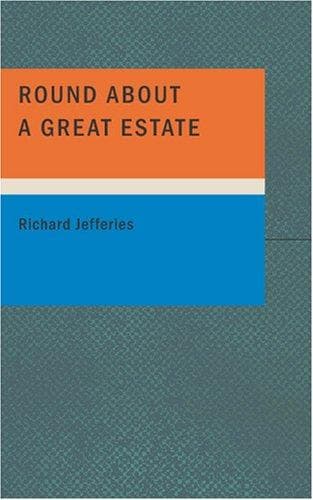
Country life -- England; Great Britain -- Description and travel
Waste lands all glorious with golden blossoming furze, with purple
foxglove, or curious orchis hiding in stray corners; wild moor-like
lands, beautiful with heaths and honey-bottle; grand stretches of
sloping downs where the hares hid in the grass, and where all the
horses in the kingdom might gallop at their will; these have been
overthrown with the plough because of the turnip. As the root crops
came in, the rage began for thinning the hedges and grubbing the
double mounds and killing the young timber, besides putting in the
drains and driving away the wild-ducks. The wicked turnip put diamonds
on the fingers of the farmer's wife, and presently raised his rent.
But now some of the land is getting 'turnip-sick,' the roots come
stringy and small and useless, so that many let it 'vall down.'
After the last crop it is left alone, the couch grows, the docks
spread out from the hedges, every species of weed starts up, till
by-and-by the ploughed land becomes green and is called pasture. This
is a process going on at the present moment, and to which owners of
land should see without delay. Hilary has been looked on somewhat
coldly by other tenants for openly calling the lord of the manor's
attention to it. He sturdily maintains that arable land if laid down
for pasture should be laid down properly--a thing that requires labour
and expenditure just the same as other farming operations. So the
silver tankard, won when 'cups' were not so common as now, is a
memorial of the old times before the plough turned up the sweet turf
of the racecourse.
Hilary does not bet beyond the modest 'fiver' which a man would be
thought unsociable if he did not risk on the horse that carries the
country's colours. But he is very 'thick' with the racing-people on
the Downs, and supplies the stable with oats, which is, I believe, not
an unprofitable commission. The historical anecdote of the Roman
emperor who fed his horse on gilded oats reads a little strange when
we first come across it in youth. But many a race-horse owner has
found reason since to doubt if it be so wonderful, as his own stud--to
judge by the cost--must live on golden fodder. Now, before I found
this out about the stable, it happened one spring day that I met
Hilary in the fields, and listened to a long tirade which he delivered
against 'wuts.'
Public-domain text, read in full here on John Shaqi.
Reviews
Reviews
No reviews yet
Be the first to share your thoughts on this work.
Join the Discussion
Join the discussion
Sign in to leave a comment or review.
Sign InorCreate an account