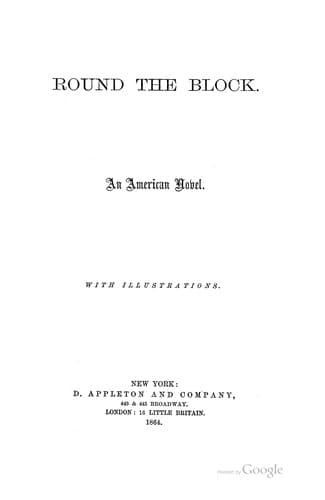
Round the Block: An American NovelBouton, John Bell
General
Round the Block: An American Novel
Bouton, John Bell
City and town life -- Fiction; Male friendship -- Fiction; New York (N.Y.) -- Social life and customs -- Fiction
J.M. Quigg, grocer, was elaborately attiring himself in the snug
sleeping room behind his store, at ten o'clock on the morning of the
eventful day. He little knew the tremendous importance of the part which
he was about to perform. He looked upon Overtop and Maltboy, not as the
expounders of a new social philosophy, but as cash customers to a
considerable extent, and as partners in defraying the heavy expenses of
a large double team. Mr. Quigg exercised the virtue of prudence even in
his dissipations, and derived pleasure from the reflection that he would
make his annual round of complimentary calls in an elegant turnout at a
moderate cost.
Therefore Mr. Quigg hummed pleasantly as he dressed himself, by the aid
of a large mirror which he had taken for a bad debt, and which was the
only ornament of the plainly furnished little room. Mr. Quigg was a man
of business, and never fretted with cravats, nor made himself unhappy on
the subject of hair. Three turns and a pull adjusted the former; and a
half dozen well-directed dabs with a stiff brush regulated the latter.
Fifteen minutes after he began his toilet, he took a comprehensive view
of himself in the large mirror, and mentally expressed the conviction
that, for a man of thirty-seven, he was not bad looking.
Quigg was right; and his just opinion of himself was shared by the young
widows and unmarried ladies of his acquaintance. He was about six feet
high, with a graceful figure, and the head of a statesman. A more
intellectual face, and a broader or more massive brow, assisted,
perhaps, in its general effect, by a slight baldness, were rarely if
ever seen. A distinguished professor of phrenology had picked out
Quigg's head from among half an acre of heads at a lecture upon that
subject in the city, and had pronounced it the "model head," greatly to
the disgust of all the other large-skulled men in the hall. The
professor had also assured Quigg, upon learning who and what he was,
that it was a solemn duty he owed to society to abandon the grocery
business, and devote himself to "philosophical culture, the development
of the humanities, and the true expansion of his interior
individuality." Notwithstanding this flattering opinion, Quigg still
sanded his sugar, and reduced his whiskey, and found his delight as well
as his-profit in those gross material pursuits.
The interior Quigg, of whom the professor had spoken so hopefully, was
still undeveloped. The professor's views of Quigg's head had, however,
made a deep impression upon the owner of it, and had given to Quigg's
ordinary observations on the weather, the state of his health, and the
other familiar topics to which his remarks were principally addressed,
an oracular importance in his own opinion. Such were the deceptive
effects produced by his large, polished brow, and slow, imposing speech,
that he always seemed to be on the point of uttering vital truths. But
the listener's ear ached in vain for them.
Public-domain text, read in full here on John Shaqi.
Reviews
Reviews
No reviews yet
Be the first to share your thoughts on this work.
Join the Discussion
Join the discussion
Sign in to leave a comment or review.
Sign InorCreate an account