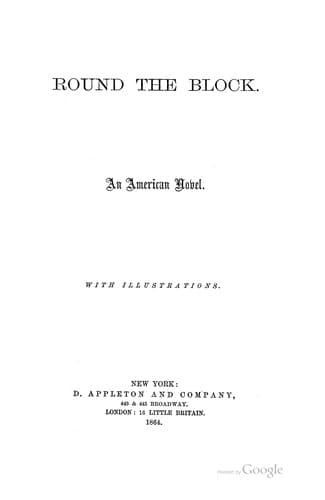
Round the Block: An American NovelBouton, John Bell
General
Round the Block: An American Novel
Bouton, John Bell
City and town life -- Fiction; Male friendship -- Fiction; New York (N.Y.) -- Social life and customs -- Fiction
When the party returned to the block where the Overtop theory was to be
tested, Mr. Quigg's services were found invaluable. He had not only been
the principal grocer in the vicinity for five years, but he had served
on Ward Committees for the relief of the poor at other people's expense,
and had participated largely in those admirable institutions for the
promotion of matrimony known as Sociables. Therefore, Quigg knew about
everybody on the block worth knowing. There were a few persons in that
old house near the corner, who sent in for herrings, cheap butter, and
pounds of flour, and whom, of course, he did not know. There was a queer
old Dutchman in that square, old-fashioned house in the middle of the
block, whom neither he nor anybody else knew.
They went through half of the south side of the block, and found only
plain and commonplace people. Overtop and Maltboy began to be weary. The
former was gradually discovering that his theory was a bore. The latter
wondered whether Quigg knew the tall girl, concerning the identity of
the front part of whose residence Maltboy was at fault, although he knew
every brick of the rear.
"In this 'ere house," said Quigg, "I shall be treated rudely, because
they owe me fifty dollars for groceries. It's a curious fact, but I have
noticed that debtors always act kind o' cold to creditors, as if it was
the creditors that owed the money."
Mr. Quigg spoke with an important air, as if he had made an original
discovery in human nature.
CHAPTER VI.
SOMETHING HIDDEN.
While this exploring party were going through the block, Mr. Marcus
Wilkeson dressed himself with more than usual care, preparatory to a
call upon the unknown old gentleman over the way, who that very morning
had appeared at his window, the first time in three days, and tendered
the compliments of the season in two low bows and a smile. Having
carefully adjusted his necktie, and smoothed the creases of his gloves,
Mr. Wilkeson grasped his old friend, a hickory cane, by its sturdy
elbow, and marched forth to make his solitary visit.
As 'he turned the corner of the street upon which the unknown old
gentleman's residence was situated, thinking of the oddity of the call
he was about to make, and half inclined to abandon it, he saw, in a
doorway a few yards in front of him, a little girl who bore a striking
resemblance to the patient creature that he had often noticed sitting at
a window in the room of the pale mechanic. A single glance at the
cracked and dirty front of the building established its connection with
the weather-stained and shaky rear premises in which the worker toiled
at his strange task from morning to night, and far into the
morning again.
The little girl was earnestly talking with a rough, hungry-looking
fellow in a greasy cap and tattered blue overalls. As Marcus approached,
he heard the following fragment of conversation:
Public-domain text, read in full here on John Shaqi.
Reviews
Reviews
No reviews yet
Be the first to share your thoughts on this work.
Join the Discussion
Join the discussion
Sign in to leave a comment or review.
Sign InorCreate an account