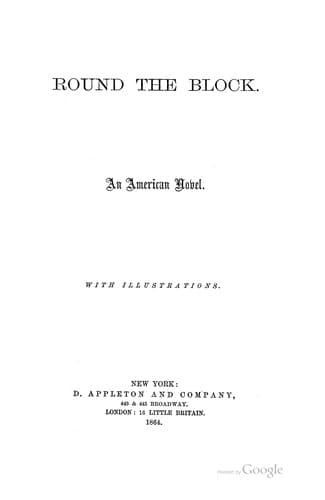
Round the Block: An American NovelBouton, John Bell
General
Round the Block: An American Novel
Bouton, John Bell
City and town life -- Fiction; Male friendship -- Fiction; New York (N.Y.) -- Social life and customs -- Fiction
The opening of the parlor door discovered a room full of men, who were
sipping wine, eating cold fowl and confections, talking and laughing
loudly with each other, or exchanging repartees with a lady who stood in
the centre of the apartment and shed her light upon all. This lady was
Mrs. Grazella Jigbee Slapman.
Previous to her marriage, she had been not altogether unknown to the
corners of several weekly newspapers, under the name of "Grazella." She
had also cultivated a natural talent for painting, so assiduously, that
a little cabinet piece of hers, representing a cat, a lobster, and a
plate of fruit, was considered good enough to exhibit in the window of a
Broadway print shop, in which her uncle was a silent partner, and was
approvingly paragraphed in a paper partly owned by her first cousin. To
gifts capable of producing results like these, she added a great
aptitude for music; although an incurable indolence, she gracefully
said, had always prevented her from learning the piano. While yet
sustaining the name of Jigbee, she had achieved a high reputation in
private circles as a merciless judge of music. But her conversation had
been, from earliest girlhood, her chief attraction. She possessed the
extraordinary faculty of talking with a dozen persons upon a dozen
different subjects at the same time.
Unlike many people similarly endowed, she did not exercise this
wonderful gift for the brutal purpose of putting down feebler
intellects, but only to elicit TRUTH, which she often declared to be the
sole object of her existence. When, by her alliance with Mr. Slapman, a
thrifty speculator in real estate, she was installed as mistress of a
fine house and furniture, and a few thousand a year, the lady naturally
gathered about her a still larger circle of admirers. Her researches for
TRUTH were met halfway by people that were supposed to deal in that
article, abstractly considered; such as poets, painters, sculptors,
reformers, inventors. Anybody with a new idea was sure to be understood
and encouraged by her. Her fondness for new ideas was as keen as an
entomologist's for new bugs or butterflies.
Mrs. Slapman had not made the mistake of neglecting her physical and
perishable charms in deference to her intellectual and immortal nature.
She was twenty-four years old, and had clear, sparkling eyes, a fresh
complexion, good teeth, rich, heavy hair, and a substantial figure. The
pursuit of TRUTH did not disagree with her health.
Mrs. Slapman bustled out of the little knot of persons about her, and
advanced in a frank, hearty way to meet her visitors. To Mr. Quigg she
nodded patronizingly, as to one whom she had long known to be guiltless
of new ideas; but to the strangers who sought her society, she addressed
a cordial smile.
Mr. Quigg, having performed his office, judiciously stepped aside, and
left the honors and burdens of conversation with the three friends.
Public-domain text, read in full here on John Shaqi.
Reviews
Reviews
No reviews yet
Be the first to share your thoughts on this work.
Join the Discussion
Join the discussion
Sign in to leave a comment or review.
Sign InorCreate an account