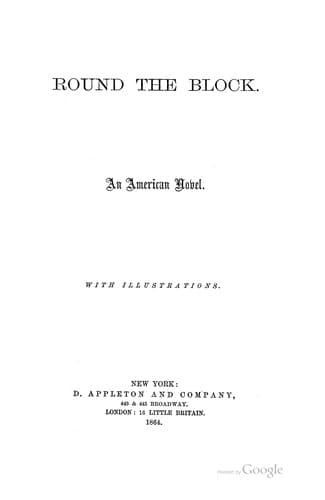
Round the Block: An American NovelBouton, John Bell
General
Round the Block: An American Novel
Bouton, John Bell
City and town life -- Fiction; Male friendship -- Fiction; New York (N.Y.) -- Social life and customs -- Fiction
With a caution born of experience, however, Mr. Minford, before
admitting the new guest to his full confidence, called upon a number of
Wall street brokers and South street merchants, to whom Marcus had
referred him, and learned from them that that gentleman bore a
reputation of the rarest honor and purity of character. While giving
this united testimony, however, they all agreed in condemning Mr.
Wilkeson's eccentricity--insanity, one broker called it--in retiring
from business at the very moment when he was most successful, and had a
great fortune within easy reach. The fact that he had retired with one
hundred and fifty thousand dollars, instead of mitigating his offence in
the eyes of those critics, increased it. "Why," said a noted bear, "with
that amount of capital, and Wilkeson's first-rate talents--when he chose
to use them--he might have become the king of Wall street. It's a pity
so smart a fellow should make a wreck of himself." And the bear heaved a
sigh of commiseration; which was by no means echoed by Mr. Minford, who
gathered, from all this evidence, an increased esteem for his
benefactor.
From the time when he first crossed the threshold of the house on his
mission of mercy, Pet had looked upon him with the deepest reverence.
She had read, in story books, of mysterious gentlemen who went about
doing good merely for the pleasure of it, and who always reached the
scene of distress with fairy-like certainty, when everybody and
everything would have gone to ruin without them. Such a strange,
supernatural embodiment of goodness seemed Marcus Wilkeson to her
childish fancy. When he entered the room--and he was an every-day caller
now--she looked around with great anxiety to see that all the chairs
were in their proper places; that there was no dirt or dust visible
anywhere; that everything was in a state of order and cleanliness worthy
so exalted a guest.
She would run to take his overcoat and hat and cane, and place them as
carefully in the clothes press as if they had been the robe, crown, and
sceptre of a king. Then she would sit in her little chair, and take her
sewing, or knitting, or embroidery, and pretend to be all absorbed in
it, while she was listening eagerly to every word that Marcus addressed
to her father, and occasionally looked up at the face of their guest,
and thought how noble it was, and how proud she should be to call
him uncle.
When he spoke to her, as he often did, and asked her about her work, or
her companions, or her studies (upon the latter subject he had grown
quite curious, of late), she would feel that she was blushing, and
answer, with downcast eyes, and be half glad and half sorry when he
ceased to question her, and would then sit and torment herself by
recalling what she had said, and thinking how much it might have
been improved.
Public-domain text, read in full here on John Shaqi.
Reviews
Reviews
No reviews yet
Be the first to share your thoughts on this work.
Join the Discussion
Join the discussion
Sign in to leave a comment or review.
Sign InorCreate an account