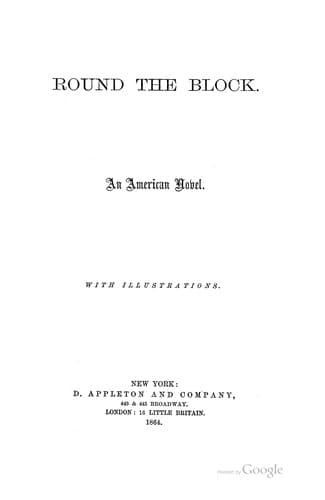
Round the Block: An American NovelBouton, John Bell
General
Round the Block: An American Novel
Bouton, John Bell
City and town life -- Fiction; Male friendship -- Fiction; New York (N.Y.) -- Social life and customs -- Fiction
"That will suit me exactly, pa," cried Pet, clapping her hands with
glee; "because then I can get your breakfast, dinner, and supper, and do
all the housework, without any interruption in my studies."
"Miss Pillbody thought the arrangement would suit you. She is a
perfectly competent teacher of French, Italian, the English branches,
music, drawing, the dead languages, and higher mathematics--quite a
prodigy, I assure you, for a lady not yet twenty-two years old." (Marcus
was addressing the father.) "I have been particular in my inquiries, and
all who know her speak in the highest terms of her remarkable
attainments, her ability to teach others, and her goodness of heart.
Your daughter will like her, without doubt."
"I know I shall," said Pet, with enthusiasm. "There are so many things
that I will learn, pa. First, music--"
"She has a fine piano, and plays splendidly," remarked the guest. "I
heard her."
"And French and Italian, to please you, pa--that is, if I can learn
them--and everything else that the lady will teach me. I shall be so
happy, sir."
The father and the guest smiled at the zeal with which this young
beginner proposed to grapple with the difficulties of human knowledge.
It was fortunate for her that a long series of hard and injudicious
teachers had not already sickened her of learning, and that she brought
a fresh and uncorrupted taste to the work.
Pet was thinking which one of her two dresses (equally faded) she should
wear to school, and what bit of ribbon or trimming she could introduce
in her old bonnet, to improve its general effect. Marcus Wilkeson was
marvelling at the confidence which the inventor and his daughter placed
in him, and at what there was about him to inspire it. Mr. Minford was
congratulating himself on having met with a man so generous and sincere
as this Mr. Wilkeson, and so entirely disinterested, too: "For,"
reasoned the inventor, "he cannot appreciate, as I do, the enormous
value of my discovery, and does not dream that his portion of it will
compensate him for his outlay more than a hundred times over."
The silence was broken by a sound as of heavy boots trying to move
softly on the stairs, and a subsequent modest rap at the door.
CHAPTER III.
AN AUXILIARY OF MODERN CIVILIZATION.
The boy Bog rapped, and entered. He was more neatly dressed than when
Marcus saw him on the occasion of his first visit. His patched and
threadbare coat was replaced by a neat roundabout jacket; his greasy,
visorless cap, by a flat felt hat, of which the brim was symmetrically
turned up; his tattered shoes by great cowhide boots. The boy was of
that age when the human frame grows with vegetable-like rapidity; and he
seemed to hare increased a little all around within three weeks.
The boy looked distressingly awkward in his new articles of attire. Had
he stolen them, he could not have appeared more guilty in presence of
the rightful owner.
Public-domain text, read in full here on John Shaqi.
Reviews
Reviews
No reviews yet
Be the first to share your thoughts on this work.
Join the Discussion
Join the discussion
Sign in to leave a comment or review.
Sign InorCreate an account