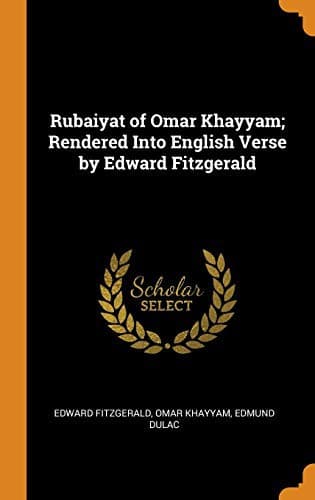
Rubáiyát of Omar Khayyam, Rendered into English VerseOmar Khayyam
GeneralSufism
Rubáiyát of Omar Khayyam, Rendered into English Verse
Omar Khayyam
Persian poetry -- Translations into English
sacrificed a fine and novel piece of imagery in his first stanza and
replaced it by one of much more ordinary character. If it were from a
dislike to pervert his original too largely, he had no need to be so
scrupulous, since he dealt on the whole with the "Rubá'iyyát" as though
he had the license of absolute authorship, changing, transposing, and
manipulating the substance of the Persian quatrains with a singular
freedom. The vogue of "old Omar" (as he would affectionately call his
work) went on increasing, and American readers took it up with
eagerness. In those days the mere mention of Omar Khayyám between two
strangers meeting fortuitously acted like a sign of freemasonry and
established frequently a bond of friendship. Some curious instances of
this have been related. A remarkable feature of the Omar-cult in the
United States was the circumstance that single individuals bought
numbers of copies for gratuitous distribution before the book was
reprinted in America. Its editions have been relatively numerous, when
we consider how restricted was the circle of readers who could
understand the peculiar beauties of the work. A third edition appeared
in 1872, with some further alterations, and may be regarded as virtually
the author's final revision, for it hardly differs at all from the text
of the fourth edition, which appeared in 1879. This last formed the
first portion of a volume entitled "Rubáiyát of Omar Khayyám; and the
Salámán and Absál of Jámí; rendered into English verse." The "Salámán"
(which had already been printed in separate form in 1856) is a poem
chiefly in blank verse, interspersed with various meters (although it is
all in one measure in the original) embodying a love-story of mystic
significance; for Jámí was, unlike Omar Khayyám, a true Súfi, and indeed
differed in other respects, his celebrity as a pious Mussulman doctor
being equal to his fame as a poet. He lived in the fifteenth century, in
a period of literary brilliance and decay; and the rich exuberance of
his poetry, full of far-fetched conceits, involved expressions,
overstrained imagery, and false taste, offers a strong contrast to the
simpler and more forcible language of Khayyám. There is little use of
Arabic in the earlier poet; he preferred the vernacular speech to the
mongrel language which was fashionable among the heirs of the Saracen
conquerors; but Jámí's composition is largely embroidered with Arabic.
Public-domain text, read in full here on John Shaqi.
Reviews
Reviews
No reviews yet
Be the first to share your thoughts on this work.
Join the Discussion
Join the discussion
Sign in to leave a comment or review.
Sign InorCreate an account