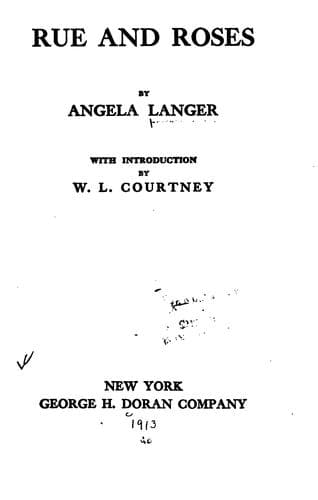
Man-woman relationships -- Fiction; Poor families -- Fiction; Young women -- Fiction
He frowned, and his handsome face darkened.
"It seems that I cannot expect from you that delicacy of feeling which
you must possess if you are ever to deserve my affection. But since you
are my sister, and really not to blame for your imperfections--because
it is the duty of parents to attend to their children's education, and
yours, I mean ours, have neglected that important thing entirely--I
will answer your question about the money. You are perfectly right in
suspecting that I have not a single penny, but let me tell you that I
would much rather walk all the distance from here to Vienna than bring
myself to accept another sou from the man who, on account of a strange
accident, is entitled to call himself my father. I have tried to find
out when the goods-train leaves for Vienna, and have decided to hide
myself in it."
I shook my head in horror.
"No, never!" I cried; "you must not do that. I have got some money,"
and I pressed the rest of my ten shillings, which I had carefully
wrapped up in a piece of white paper, into his hand; whereupon I
detected signs of both anger and pity on his face.
"Surely," he said, "I should be a scoundrel of the meanest order if I
touched this small sum of yours. Far be it from me to do such a thing;"
and he put the money back into my hand. "It is true," he added, "that
you have shown great tactlessness again, but I will forgive you this
time."
Almost immediately he was gone, and although I was standing in the
street, I began to cry most piteously, regretting my poverty, my lack
of nobleness, even my very existence. I felt convinced that my brother
was not only an artist, but also a hero and a martyr.
Chapter VII
The situation in which I started soon after these events differed
somewhat from my first one. There were only three children, a second
maid--the cook--and instead of eight shillings I was promised ten
shillings a month. My duties were the same as before. I had to wash up
the dishes, to scrub the floor, and to take out the children as soon as
I had finished the housework. My new charges behaved much better than
the children of the manager, and I liked them all very much. The cook,
too, was nice. Neither in speech nor in manner was she objectionable,
and sometimes I used to read out my poems to her. She seemed to be very
fond of the verses, and often asked to hear them again. That made me
very happy.
But after some months had passed away, and I became used to the change,
I was conscious again of the old well-known feeling of dissatisfaction
and loneliness. Frequently I used to sit down in a corner and sob
without knowing what was the matter. I was careful not to let the
mistress see my tears, but could not always hide them from the cook,
who was nearly always with me. She had asked me already what I was
crying for, but I could give no explanation.
Public-domain text, read in full here on John Shaqi.
Reviews
Reviews
No reviews yet
Be the first to share your thoughts on this work.
Join the Discussion
Join the discussion
Sign in to leave a comment or review.
Sign InorCreate an account