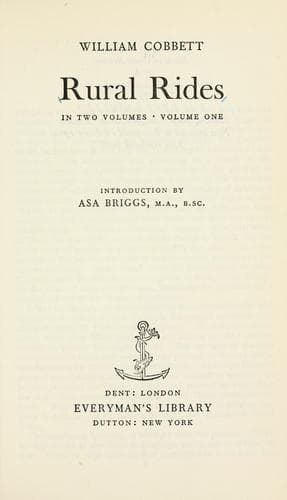
Great Britain -- Description and travel; Great Britain -- Rural conditions
Passing over several other topics, let me, Gentlemen, now come to what,
at the present moment, most nearly affects you; namely, the _prospect as
to prices_. In the first place, this depends upon whether Peel's Bill
will be repealed. As this depends a good deal upon the Ministers, and as
I am convinced, that they know no more what to do in the present
emergency than the little boys and girls that are running up and down
the street before this house, it is impossible for me, or for any one,
to say what will be done in this respect. But my opinion is decided,
that the Bill will _not_ be repealed. The Ministers see, that, if they
were _now_ to go back to the paper, it would not be the paper of 1819;
but a paper never to be redeemed by gold; that it would be _assignats_
to all intents and purposes. That must of necessity cause the complete
overthrow of the Government in a very short time. If, therefore, the
Ministers see the thing in this light, it is impossible, that they
should think of a repeal of Peel's Bill. There appeared, last winter, a
strong disposition to repeal the Bill; and I verily believe, that a
repeal in effect, though not in name, was actually in contemplation. A
Bill was brought in, which was described beforehand as intended to
prolong the issue of small notes, and also to prolong the time for
making Bank of England notes a legal tender. This would have been a
repealing of Peel's Bill in great part. The Bill, when brought in, and
when passed, as it finally was, contained no clause relative to legal
tender; and without that clause it was perfectly nugatory. Let me
explain to you, Gentlemen, what this Bill really is. In the seventeenth
year of the late King's reign, an act was passed for a time limited, to
prevent the issue of notes payable to bearer on demand, for any sums
less than five pounds. In the twenty-seventh year of the late King's
reign, this Act was made _perpetual_; and the preamble of the Act sets
forth, that it is made perpetual, because the _preventing of small notes
being made has been proved to be for the good of the nation_.
Nevertheless, in just ten years afterwards; that is to say, in the year
one thousand seven hundred and ninety-seven, when the Bank stopped
payment, this salutary Act was _suspended_; indeed, it was absolutely
necessary, for there was no gold to pay with. It continued suspended
until 1819, when Mr. Peel's Bill was passed, when a Bill was passed to
suspend it still further, until the year 1825. You will observe, then,
that, last winter there were yet three years to come, during which the
banks might make small notes if they would. Yet this new Bill was passed
last winter to authorize them to make small notes until the year 1833.
The measure was wholly uncalled for. It appeared to be altogether
unnecessary; but, as I have just said, the intention was to introduce
into this Bill a clause to continue the _legal tender_ until 1833; and
Public-domain text, read in full here on John Shaqi.
Reviews
Reviews
No reviews yet
Be the first to share your thoughts on this work.
Elsewhere in the archive
Join the Discussion
Join the discussion
Sign in to leave a comment or review.
Sign InorCreate an account