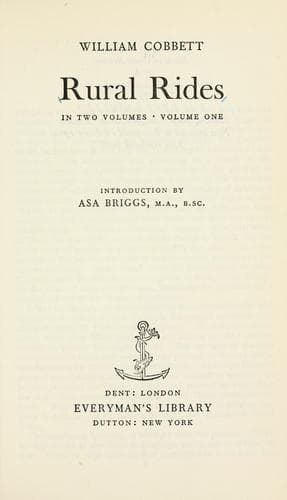
Great Britain -- Description and travel; Great Britain -- Rural conditions
At Burghclere. Very nasty weather. On the 28th the fox-hounds came to
throw off at _Penwood_, in this parish. Having heard that _Dundas_ would
be out with the hounds, I rode to the place of meeting, in order to look
him in the face, and to give him an opportunity to notice, on his own
peculiar dunghill, what I had said of him at Newbury. He came. I rode up
to him and about him; but he said not a word. The company entered the
wood, and I rode back towards my quarters. They found a fox, and quickly
lost him. Then they came out of the wood and came back along the road,
and met me, and passed me, they as well as I going at a foot pace. I had
plenty of time to survey them all well, and to mark their looks. I
watched Dundas's eyes, but the devil a bit could I get them to turn _my
way_. He is _paid_ for the present. We shall see, whether he will go, or
send an ambassador, or neither, when I shall be at Reading on the 9th of
next month.
_30 October._
Set off for London. Went by Alderbridge, Crookham, Brimton, Mortimer,
Strathfield Say, Heckfield Heath, Eversley, Blackwater, and slept at
Oakingham. This is, with trifling exceptions, a miserably poor country.
Burghclere lies along at the foot of a part of that chain of hills,
which, in this part, divide Hampshire from Berkshire. The parish just
named is, indeed, in Hampshire, but it forms merely the foot of the
Highclere and Kingsclere Hills. These hills, from which you can see all
across the country, even to the Isle of Wight, are of chalk, and with
them, towards the North, ends the chalk. The soil over which I have come
to-day, is generally a stony sand upon a bed of gravel. With the
exception of the land just round Crookham and the other villages,
nothing can well be poorer or more villanously ugly. It is all first
cousin to Hounslow Heath, of which it is, in fact, a continuation to the
Westward. There is a clay at the bottom of the gravel; so that you have
here nasty stagnant pools without fertility of soil. The rushes grow
amongst the gravel; sure sign that there is clay beneath to hold the
water; for, unless there be water constantly at their roots, rushes will
not grow. Such land is, however, good for _oaks_ wherever there is soil
enough on the top of the gravel for the oak to get hold, and to send its
tap-root down to the clay. The oak is the thing to plant here; and,
_therefore_, this whole country contains not one single plantation of
oaks! That is to say, as far as I observed. Plenty of _fir_-trees and
other rubbish have been recently planted; but no oaks.
Public-domain text, read in full here on John Shaqi.
Reviews
Reviews
No reviews yet
Be the first to share your thoughts on this work.
Elsewhere in the archive
Join the Discussion
Join the discussion
Sign in to leave a comment or review.
Sign InorCreate an account