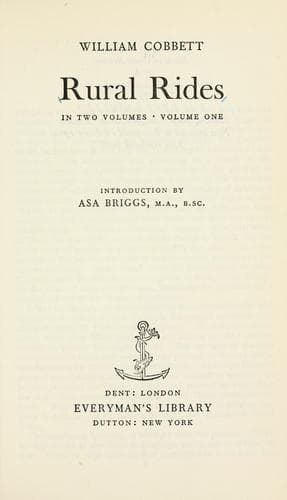
Great Britain -- Description and travel; Great Britain -- Rural conditions
The scheme that appears to have been fallen upon for this purpose is the
strangest in the world, and it must, if attempted to be put into
execution, produce something little short of open and general commotion;
namely, that of reducing the wages of labour to a mark so low as to make
the labourer a walking skeleton. Before I proceed further, it is right
that I communicate to you an explanation, which, not an hour ago, I
received from Mr. Poulter, relative to the _manifesto_, lately issued in
this town by a Bench of Magistrates of which that gentleman was
Chairman. I have not the honour to be personally acquainted with Mr.
Poulter, but certainly, if I had misunderstood the manifesto, it was
right that I should be, if possible, made to understand it. Mr. Poulter,
in company with another gentleman, came to me in this Inn, and said,
that the bench did not mean that their resolutions should have the
effect of _lowering the wages_: and that the sums, stated in the paper,
were sums to be given in the way of _relief_. We had not the paper
before us, and, as the paper contained a good deal about relief, I, in
recollection, confounded the two, and said, that I had understood the
paper agreeably to the explanation. But upon looking at the paper again,
I see, that, as to the _words_, there was a clear recommendation to make
the _wages_ what is there stated. However, seeing that the Chairman
himself disavows this, we must conclude that the bench put forth words
not expressing their meaning. To this I must add, as connected with the
manifesto, that it is stated in that document, that such and such
justices were present, and a large and respectable number of yeomen who
had been invited to attend. Now, Gentlemen, I was, I must confess,
struck with this addition to the bench. These gentlemen have not been
accustomed to treat farmers with so much attention. It seemed odd, that
they should want a set of farmers to be present, to give a sort of
sanction to their acts. Since my arrival in Winchester, I have found,
however, that having them present was not all; for that the names of
some of these yeomen were actually inserted in the manuscript of the
manifesto, and that those names were expunged _at the request of the
parties named_. This is a very singular proceeding, then, altogether. It
presents to us a strong picture of the diffidence, or modesty (call it
which you please) of the justices; and it shows us, that the yeomen
present did not like to have _their names_ standing as giving sanction
to the resolutions contained in the manifesto. Indeed, they knew well,
that those resolutions never could be acted upon. They knew that they
could not live in safety even in the same village with labourers, paid
at the rate of 3, 4, and 5 shillings a-week.
Public-domain text, read in full here on John Shaqi.
Reviews
Reviews
No reviews yet
Be the first to share your thoughts on this work.
Elsewhere in the archive
Join the Discussion
Join the discussion
Sign in to leave a comment or review.
Sign InorCreate an account