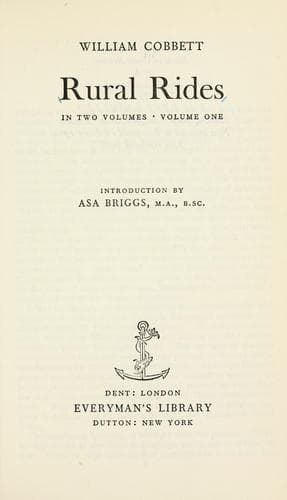
Great Britain -- Description and travel; Great Britain -- Rural conditions
To return, now, Gentlemen, to the scheme for squeezing rents out of the
bones of the labourer, is it not, upon the face of it, most monstrously
absurd, that this scheme should be resorted to, when the plain and easy
and just way of insuring rents must present itself to every eye, and can
be pursued by the Parliament whenever it choose? We hear loud outcries
against the poor-rates; the _enormous_ poor-rates; the _all-devouring_
poor-rates; but what are the facts? Why, that, in Great Britain, _six
millions_ are paid in poor-rates, _seven millions_ (or thereabouts) in
_tithes_, and _sixty millions_ to the fund-people, the army, placemen,
and the rest. And yet nothing of all this seems to be thought of but the
_six_ millions. Surely the other and so much larger sums might to be
thought of. Even the _six_ millions are, for the far greater part,
_wages_ and not poor-rates. And yet all this outcry is made about these
_six_ millions, while not a word is said about the other _sixty-seven_
millions.
Gentlemen, to enumerate all the ways, in which the public money is
spent, would take me a week. I will mention two classes of persons who
are receivers of taxes: and you will then see with what _reason_ it is,
that this outcry is set up against the poor-rates and against the amount
of wages. There is a thing called the _Dead Weight_. Incredible as it
may seem, that such a vulgar appellation should be used in such a way
and by such persons, it is a fact, that the Ministers have laid before
the Parliament an account, called the account of the _Dead Weight_. This
account tells how five millions three hundred thousand pounds are
distributed annually amongst half-pay officers, pensioners, retired
commissaries, clerks, and so forth, employed during the last war. If
there were nothing more entailed upon us by that war, this is pretty
smart-money. Now unjust, unnecessary as that war was, detestable as it
was in all its principles and objects, still, to every man, who really
did _fight_, or who performed a soldier's duty abroad, I would give
_something_: he should not be left destitute. But, Gentlemen, is it
right for the nation to keep on paying for life crowds of young fellows
such as make up the greater part of this _dead weight_? This is not all,
however, for, there are the widows and the children, who have, and are
to have, _pensions too_. You seem surprised, and well you may; but this
is the fact. A young fellow who has a pension for life, aye, or an old
fellow either, will easily get a wife to enjoy it with him, and he will,
I'll warrant him, take care that _she_ shall not be _old_. So that here
is absolutely a premium for entering into the holy state of matrimony.
The husband, you will perceive, cannot prevent the wife from having the
pension after his death. She is _our widow_, in this respect, not his.
She marries, in fact, with a jointure settled on her. The more children
the husband leaves the better for the widow; for each child has a
Public-domain text, read in full here on John Shaqi.
Reviews
Reviews
No reviews yet
Be the first to share your thoughts on this work.
Elsewhere in the archive
Join the Discussion
Join the discussion
Sign in to leave a comment or review.
Sign InorCreate an account