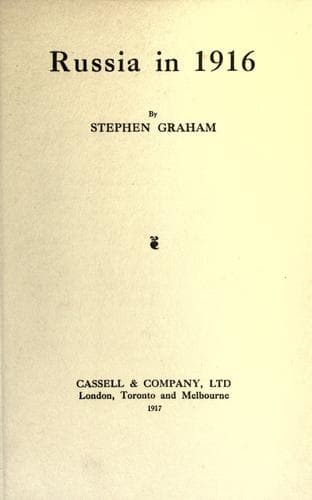
Russia -- Description and travel; Russia -- Social life and customs
No doubt Gorky makes an appeal in these words; and if the average
Russian were asked what were the foundations of Anglo-Russian
friendship apart from the needs of the war, he would answer,
Commercial exploitation. Trade, it is true, is put jealously forward
as something to be captured after the war; but it seems a pity that
Russians should not realise the depth, the sincerity of our interest
in their characteristic religion, literature, and life. Whatever
political tendency our interest may help, it is nevertheless true that
England obtains from Russia spiritual help; and a great deal of that
which Gorky condemns in his own nation is coming to our help to redeem
us from commercialism and materialism. It is something of a paradox
that the bright spirits of Russia should hate the melancholy vistas of
Tambof and Kaluga and that the bright spirits of England should hate
the gloom of Newcastle and Leeds, that one should look with love from
England to the wandering pilgrims of Tambof and the other should sigh
for the clamour of wheels where “man at least is master.” But paradox
is tolerable where misunderstanding is not. For paradoxes abound in
truth, and truth is made up of such paradoxes.
Later on in his essay Gorky remarks that stormy and revolutionary
eras have produced great men, and his first example is Shakespeare,
who flourished “in the stormy time of Queen Elizabeth.” But rather,
they were “spacious days”; and great men, great thoughts are almost
always born in spacious days, halcyon days, when the dove broods on
waters. Strength is with calmness, not with noise and quarrellings and
revolutions. The critics are probably right when they say, “Return to
Art.” Art is creative, whereas argument is generally destructive. And
Maxim Gorky evidently wishes to create.
Maxim Gorky may be called the leader of the _porazhentsi_, the people
who believe in defeat. He has lately added to “Two Souls” and “A
Letter to the Reader”--the “Letters of William Simpleton, a Knowing
Stranger.”[5] But it is what we call “half-baked.” Gorky has read an
enormous number of books since he tucked his blouse inside and became
respectable, but it is difficult to see where he, or the reader, has
profited. He does not know where he is.
[5] Published in _Lietopis_ anonymously but generally ascribed to
Gorky.
IX
RUSSIA IN 1916
I WAS in Russia at the beginning of the war and during the
first months of conflict, and I witnessed the superb enthusiasm with
which she rose to fight. Again I was in Russia last year, when, owing
to the general shortage of shells west and east, Germany was able
to turn her superiority to account by retaking Galicia and ravaging
Poland, and I saw the humiliation almost amounting to despair of Russia
then. And therefore returning once more to Russia in June, 1916, I
could form a fairly just idea of the spirit of Russia to-day.
Public-domain text, read in full here on John Shaqi.
Reviews
Reviews
No reviews yet
Be the first to share your thoughts on this work.
Join the Discussion
Join the discussion
Sign in to leave a comment or review.
Sign InorCreate an account