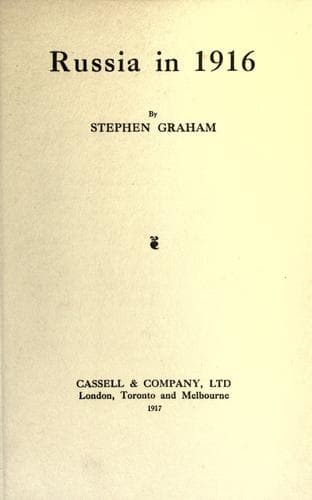
Russia -- Description and travel; Russia -- Social life and customs
Well, grant everything, admit all that can be said against him, and
subtract all from Holy Russia. I am not afraid to do it. I have had to
do it long ago for myself. And there still remains Holy Russia, the
beautiful, spiritual individuality of the nation.
XVI
THE PROSPECTS FOR PEACE
THE year 1916 closes in peace discussion. There has always seemed to me
to be a likelihood that the war, the khaki and the guns, the gallant
men and the sacred graves alike would be snowed over with papers and
eventually almost lost sight of. Some eloquent German pastor cried out
in a war sermon--
_“White snow, white snow, fall, fall for seven weeks; all may’st thou
cover, far and wide, but never England’s shame; white snow, white snow,
never the sins of England.”_
Our attitude would be rather: Never the sins of Germany. But even they
must be covered at last. And the snow which the pastor asked for has
begun to fall, blown by a somewhat gusty westerly wind.
It is America that is sending it across and I imagine that Americans
would be specially interested what Russians think of the prospects for
peace.
The problem of peace as it affects Russia differs somewhat from the
problem as it affects France and Britain. It is well to keep in view
the central facts.
Germany made war on Russia and showed herself ready to sacrifice Russia
on the altar of her own greatness. The Kaiser so far from being on
friendly terms with the Tsar, set out to despoil the Tsar of tracts of
territory. Russia being an autocracy much more depended on the Tsar and
his ministers than on the Duma or the voice of the people manifested
in the press. He answered War with War. As far as can be ascertained
no attempt was made by so-called “Germans at court” to stave off war
or make a pact with Germany and sacrifice France. Several large German
landowners sold their estates and returned to the Fatherland before
the war broke out, for they knew the cash was coming. Germany did not
wish to come to an understanding with Russia before July, 1914. Germany
thought it more profitable to sacrifice the Russians than to share with
them power in Europe.
The German people confident in the possession of an enormous armament
and of a genius for organisation which put them first and the
rest nowhere, despised Russia. Russia’s friendship was not worth
striving to obtain. There were admirable foundations for building a
German-Russian friendship of a most lucrative kind, deep German roots
in finance, commerce, government and administration and blood ties and
inter-marriages amongst important German and Russian families, but it
was thought to be more profitable to fight than to be friends.
Public-domain text, read in full here on John Shaqi.
Reviews
Reviews
No reviews yet
Be the first to share your thoughts on this work.
Join the Discussion
Join the discussion
Sign in to leave a comment or review.
Sign InorCreate an account