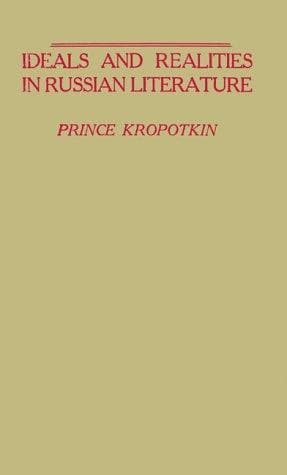
Russian literatureKropotkin, Petr Alekseevich, kniaz
History
Russian literature
Kropotkin, Petr Alekseevich, kniaz
Russian literature -- 19th century -- History and criticism
Ryeshétnikoff’s position in literature is quite unique. “The sound
truth of Ryeshétnikoff”--in these words Turguéneff characterised his
writings. It is truth, indeed, nothing but truth, without any attempt
at decoration or lyric effects--a sort of diary in which the men
with whom the author lived in the mining works of the Uráls, in his
Permian village, or in the slums of St. Petersburg, are described.
“Podlípovtsy” means the inhabitants of a small village Podlípnaya, lost
somewhere in the mountains of the Uráls. They are Permians, not yet
quite Russified, and are still in the stage which so many populations
of the Russian Empire are living through nowadays--namely the early
agricultural. Few of them have for more than two months a year pure
rye-bread to eat: the remaining ten months they are compelled to add
the bark of trees to their flour in order to have “bread” at all. They
have not the slightest idea of what Russia is, or of the State, and
very seldom do they see a priest. They hardly know how to cultivate the
land. They do not know how to make a stove, and periodical starvation
during the months from January to July has taken the very soul and
heart out of them. They stand on a lower level than real savages.
One of their best men, Pilá, knows how to count up to five, but the
others are unable to do so. Pilá’s conceptions of space and time are
of the most primitive description, and yet this Pilá is a born leader
of his semi-savage village people, and is continually making something
for them. He tells them when it is time to plough; he tries to find a
sale for their small domestic industries; he knows how to go to the
next town, and when there is anything to be done there, he does it. His
relations with his family, which consists of an only daughter, Apróska,
are at a stage belonging to prehistorical anthropology, and yet he and
his friend Sysói love that girl Apróska so deeply, that after her death
they are ready to kill themselves. They abandon their village to lead
the hard life of boatmen on the river, dragging the heavy boats up the
current. But these semi-savages are deeply human, and one feels that
they are so, not merely because the author wants it, but in reality;
and one cannot read the story of their lives and the sufferings which
they endure, with the resignation of a patient beast, without being
moved at times even more deeply than by a good novel from our own life.
Public-domain text, read in full here on John Shaqi.
Reviews
Reviews
No reviews yet
Be the first to share your thoughts on this work.
Elsewhere in the archive
Join the Discussion
Join the discussion
Sign in to leave a comment or review.
Sign InorCreate an account