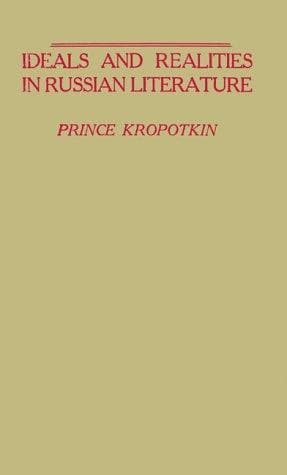
Russian literatureKropotkin, Petr Alekseevich, kniaz
History
Russian literature
Kropotkin, Petr Alekseevich, kniaz
Russian literature -- 19th century -- History and criticism
A work of very great value, which is still in progress, is the
_Biographic Dictionary of Russian Writers_, published and nearly
entirely written by S. Venguéroff, who is also the editor of new,
scientifically prepared editions of the complete works of several
authors (Byelínskiy is now published). Excellent biographies and
critical sketches of all Russian writers will be found in the _Russian
Encyclopædia Dictionary_ of Brockhaus-Efron. The first two volumes of
this Dictionary (they will be completed in an Appendix) were brought
out as a translation of the _Lexikon_ of Brockhaus; but the direction
was taken over in good time by a group of Russian men of science,
including Mendeléeff, Woiéikoff, V. Solovióff, etc., who have made of
the 82 volumes of this _Dictionary_, completed in 1904 (at 6 sh. the
volume)--one of the best encyclopædias in Europe. Suffice it to say
that all articles on chemistry and chemical technics have been either
written or carefully revised by Mendeléeff.
Complete editions of the works of most of the Russian writers have
lately been published, some of them by the editor Marks, in connection
with his weekly illustrated paper, at astoundingly low prices, which
can only be explained by a circulation which exceeds 200,000 copies
every year. The work of Gógol, Turguéneff, Gontcharóff, Ostróvskiy,
Boborýkin, Tchéhoff, and some minor writers, like Danilévskiy and
Lyeskóff, are in this case.
FOOTNOTES:
[24] I borrow these remarks about the predecessors of Byelínskiy from
an article on Literary Criticism in Russia, by Professor Ivánoff, in
the _Russian Encyclopædic Dictionary_, Vol. 32, 771.
[25] The speech of Homyakóff is reproduced in Skabitchévskiy’s
_History_ (l. c.). I was very anxious to get Tolstóy’s speech, because
I think that the ideas he expressed about “the permanent in Art, the
universal” hardly did exclude the denunciation of the ills from which a
society suffers at a given moment. Perhaps he meant what Nekrásoff also
meant when he described the literature to which Schédrin’s _Provincial
Sketches_ had given origin as “a flagellation of the petty thieves
for the pleasure of the big ones.” Unfortunately, this speech was not
printed, and the manuscript of it could not be found.
INDEX
Abolition of serfdom committees, 119
Absolutism, historical necessity of, 272
Æsthetics, philosophical, 287
theories of, 290
of the leisured class, 306
Agricultural Academy of Moscow, 302
Agricultural labourers in Western Europe, hardships of, 267
Agricultural population of Russia, immense, 244
Agricultural village, life in an, 245
“Akib, the Assyrian King,” 8
Aksákoff, Iván, 176
Konstantín, 176
Serghéi Timoféevitch, prose writer, 176;
a Slavophile, 268, 269, 301
Alexander the Great, legends of, 8
Public-domain text, read in full here on John Shaqi.
Reviews
Reviews
No reviews yet
Be the first to share your thoughts on this work.
Elsewhere in the archive
Join the Discussion
Join the discussion
Sign in to leave a comment or review.
Sign InorCreate an account