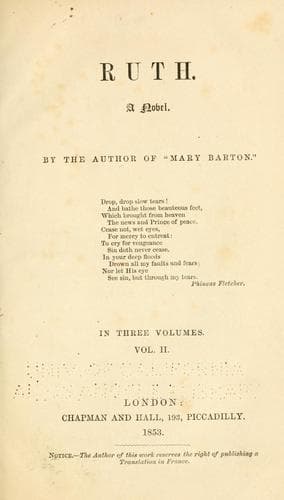
Domestic fiction; England -- Fiction; Mothers and sons -- Fiction; Religious fiction; Unmarried mothers -- Fiction
Autumn and winter, with their lowering skies, were less dreary than
the woeful, desolate feelings that shed a gloom on Jemima. She found
too late that she had considered Mr Farquhar so securely her own
for so long a time, that her heart refused to recognise him as lost
to her, unless her reason went through the same weary, convincing,
miserable evidence day after day, and hour after hour. He never spoke
to her now, except from common civility. He never cared for her
contradictions; he never tried, with patient perseverance, to bring
her over to his opinions; he never used the wonted wiles (so tenderly
remembered now they had no existence but in memory) to bring her
round out of some wilful mood--and such moods were common enough
now! Frequently she was sullenly indifferent to the feelings of
others--not from any unkindness, but because her heart seemed
numb and stony, and incapable of sympathy. Then afterwards her
self-reproach was terrible--in the dead of night, when no one saw it.
With a strange perversity, the only intelligence she cared to hear,
the only sights she cared to see, were the circumstances which gave
confirmation to the idea that Mr Farquhar was thinking of Ruth for a
wife. She craved with stinging curiosity to hear something of their
affairs every day; partly because the torture which such intelligence
gave was almost a relief from the deadness of her heart to all other
interests.
And so spring (_gioventu dell'anno_) came back to her, bringing all
the contrasts which spring alone can bring to add to the heaviness of
the soul. The little winged creatures filled the air with bursts of
joy; the vegetation came bright and hopefully onwards, without any
check of nipping frost. The ash-trees in the Bradshaws' garden were
out in leaf by the middle of May, which that year wore more the
aspect of summer than most Junes do. The sunny weather mocked Jemima,
and the unusual warmth oppressed her physical powers. She felt very
weak and languid; she was acutely sensible that no one else noticed
her want of strength; father, mother, all seemed too full of other
things to care if, as she believed, her life was waning. She herself
felt glad that it was so. But her delicacy was not unnoticed by all.
Her mother often anxiously asked her husband if he did not think
Jemima was looking ill; nor did his affirmation to the contrary
satisfy her, as most of his affirmations did. She thought every
morning, before she got up, how she could tempt Jemima to eat, by
ordering some favourite dainty for dinner; in many other little ways
she tried to minister to her child; but the poor girl's own abrupt
irritability of temper had made her mother afraid of openly speaking
to her about her health.
Public-domain text, read in full here on John Shaqi.
Reviews
Reviews
No reviews yet
Be the first to share your thoughts on this work.
Elsewhere in the archive
Join the Discussion
Join the discussion
Sign in to leave a comment or review.
Sign InorCreate an account