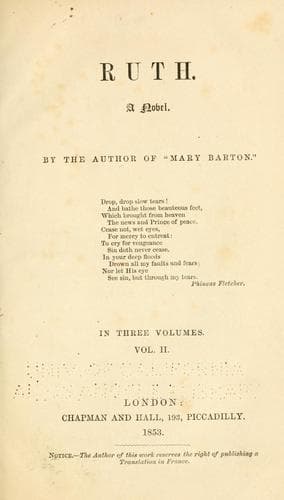
Domestic fiction; England -- Fiction; Mothers and sons -- Fiction; Religious fiction; Unmarried mothers -- Fiction
Mr and Miss Benson had about thirty or forty pounds coming in
annually from a sum which, in happier days, Mr Bradshaw had invested
in Canal shares for them. Altogether their income did not fall much
short of a hundred a year, and they lived in the Chapel-house free of
rent. So Ruth's small earnings were but very little in actual hard
commercial account, though in another sense they were much; and Miss
Benson always received them with quiet simplicity. By degrees, Mr
Benson absorbed some of Ruth's time in a gracious and natural way. He
employed her mind in all the kind offices he was accustomed to render
to the poor around him. And as much of the peace and ornament of life
as they gained now, was gained on a firm basis of truth. If Ruth
began low down to find her place in the world, at any rate there was
no flaw in the foundation.
Leonard was still their great anxiety. At times the question seemed
to be, could he live through all this trial of the elasticity of
childhood? And then they knew how precious a blessing--how true a
pillar of fire, he was to his mother; and how black the night, and
how dreary the wilderness would be, when he was not. The child and
the mother were each messengers of God--angels to each other.
They had long gaps between the pieces of intelligence respecting
the Bradshaws. Mr Bradshaw had at length purchased the house at
Abermouth, and they were much there. The way in which the Bensons
heard most frequently of the family of their former friends, was
through Mr Farquhar. He called on Mr Benson about a month after the
latter had met Jemima in the street. Mr Farquhar was not in the habit
of paying calls on any one; and though he had always entertained and
evinced the most kind and friendly feeling towards Mr Benson, he had
rarely been in the Chapel-house. Mr Benson received him courteously,
but he rather expected that there would be some especial reason
alleged, before the conclusion of the visit, for its occurrence; more
particularly as Mr Farquhar sat talking on the topics of the day in a
somewhat absent manner, as if they were not the subjects most present
to his mind. The truth was, he could not help recurring to the last
time when he was in that room, waiting to take Leonard a ride, and
his heart beating rather more quickly than usual at the idea that
Ruth might bring the boy in when he was equipped. He was very full
now of the remembrance of Ruth; and yet he was also most thankful,
most self-gratulatory, that he had gone no further in his admiration
of her--that he had never expressed his regard in words--that no one,
as he believed, was cognisant of the incipient love which had grown
partly out of his admiration, and partly out of his reason. He was
thankful to be spared any implication in the nine-days' wonder which
her story had made in Eccleston. And yet his feeling for her had been
of so strong a character, that he winced, as with extreme pain, at
every application of censure to her name.
Public-domain text, read in full here on John Shaqi.
Reviews
Reviews
No reviews yet
Be the first to share your thoughts on this work.
Elsewhere in the archive
Join the Discussion
Join the discussion
Sign in to leave a comment or review.
Sign InorCreate an account