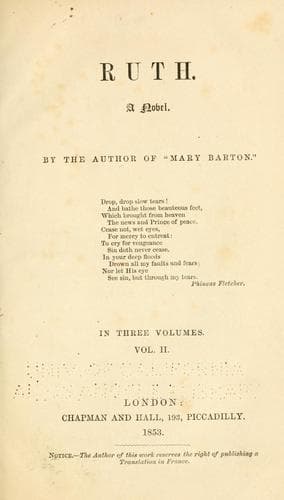
Domestic fiction; England -- Fiction; Mothers and sons -- Fiction; Religious fiction; Unmarried mothers -- Fiction
These censures were often
exaggerated, it is true; but when they were just in their judgment of
the outward circumstances of the case, they were not the less painful
and distressing to him. His first rebound to Jemima was occasioned by
Mrs Bradshaw's account of how severely her husband was displeased at
her daughter's having taken part with Ruth; and he could have thanked
and almost blessed Jemima when she dropped in (she dared do no more)
her pleading excuses and charitable explanations on Ruth's behalf.
Jemima had learnt some humility from the discovery which had been
to her so great a shock; standing, she had learnt to take heed lest
she fell; and when she had once been aroused to a perception of the
violence of the hatred which she had indulged against Ruth, she was
more reticent and measured in the expression of all her opinions. It
showed how much her character had been purified from pride, that now
she felt aware that what in her was again attracting Mr Farquhar was
her faithful advocacy of her rival, wherever such advocacy was wise
or practicable. He was quite unaware that Jemima had been conscious
of his great admiration for Ruth; he did not know that she had ever
cared enough for him to be jealous. But the unacknowledged bond
between them now was their grief, and sympathy, and pity for Ruth;
only in Jemima these feelings were ardent, and would fain have
become active; while in Mr Farquhar they were strongly mingled
with thankfulness that he had escaped a disagreeable position,
and a painful notoriety. His natural caution induced him to make
a resolution never to think of any woman as a wife until he had
ascertained all her antecedents, from her birth upwards; and the
same spirit of caution, directed inwardly, made him afraid of giving
too much pity to Ruth, for fear of the conclusions to which such
a feeling might lead him. But still his old regard for her, for
Leonard, and his esteem and respect for the Bensons, induced him to
lend a willing ear to Jemima's earnest entreaty that he would go and
call on Mr Benson, in order that she might learn something about the
family in general, and Ruth in particular. It was thus that he came
to sit by Mr Benson's study fire, and to talk, in an absent way, to
that gentleman. How they got on the subject he did not know, more
than one-half of his attention being distracted; but they were
speaking about politics, when Mr Farquhar learned that Mr Benson took
in no newspaper.
"Will you allow me to send you over my _Times_? I have generally
done with it before twelve o'clock, and after that it is really
waste-paper in my house. You will oblige me by making use of it."
"I am sure I am very much obliged to you for thinking of it. But do
not trouble yourself to send it; Leonard can fetch it."
"How is Leonard now?" asked Mr Farquhar, and he tried to speak
indifferently; but a grave look of intelligence clouded his eyes as
he looked for Mr Benson's answer. "I have not met him lately."
Public-domain text, read in full here on John Shaqi.
Reviews
Reviews
No reviews yet
Be the first to share your thoughts on this work.
Elsewhere in the archive
Join the Discussion
Join the discussion
Sign in to leave a comment or review.
Sign InorCreate an account